

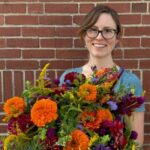
I have the pleasure of managing the cut flower operation at White Violet Center for Eco-Justice, a ministry of the Sisters of Providence of Saint Mary-of-the-Woods, Indiana.
I’m responsible for the annual crop plan, seeding, growing, tending and harvesting the flowers as well as arranging them for market and direct sales to florists and other customers.
While I may be the person in charge of growing flowers here today, I’m certainly not the first. Mother Theodore grew a variety of healing flowers and herbs.
The first greenhouse, built in 1849, was used for botanical artwork, some of which still graces the walls in Providence Hall. Historical records, courtesy of the Saint Mary-of-the-Woods Archives, also indicate a greenhouse was built in 1908 “for growing, propagating and cultivating flowers and for no other purpose.”
In other words, as long as the sisters have been at Saint Mary-of-the-Woods, there have been flowers.
In the early years of White Violet Center, most of the garden was dedicated to produce, with small pockets of flowers to attract beneficial insects.
When I first began volunteering on the farm in 2004, nicotiana towered at the ends of the tomato beds, marigolds dotted the spaces between squash plants, and nasturtiums provided a living ground cover near the peppers with clusters of bright zinnias scattered about.
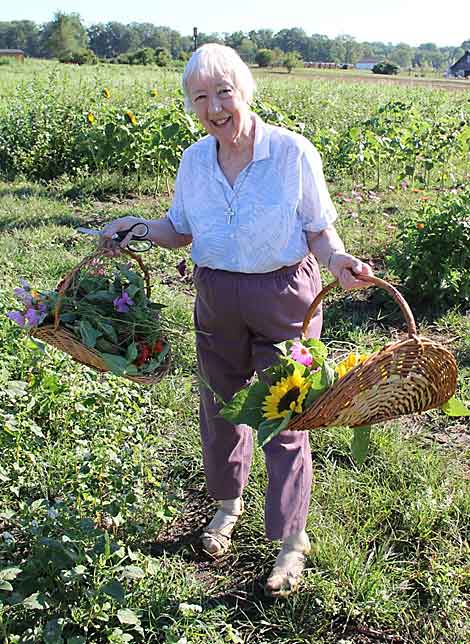
The flowers also brought color, whimsy and delight to folks working in the field and sisters who would venture out to cut some for the church and chapels. I have fond memories of the late Sister Joan Matthews walking out to the garden with her woven flower baskets and a heartfelt, crooning greeting, “Hel-Ooo, dear! Isn’t this a wonderful day?”
Soon after the Terre Haute Farmers Market began in 2005, we began offering small mixed bouquets in mason jars, as time and harvests allowed.
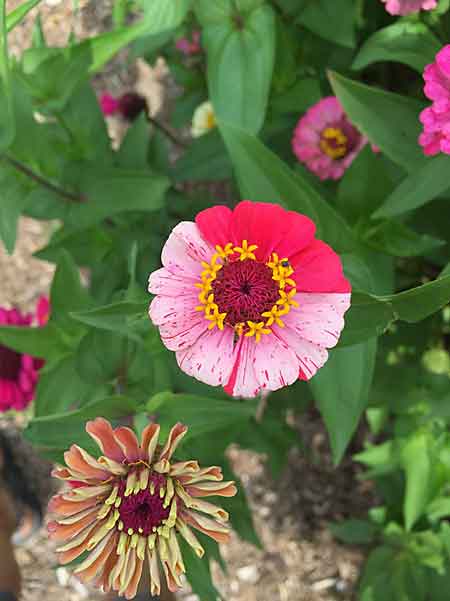
Former White Violet Center garden manager, Mark Trela, and assistant manager, Alicia Ellingsworth, began saving a mix of our own zinnia seeds in kaleidoscopic and opalescent colors.
Those multifaceted zinnias helped ignite my interest in seed saving and opened my eyes to the possibilities of plant selection. Sometimes, plant mutations are beautiful!
In late 2009, when I took the helm as garden manager, I set aside a dedicated flower patch on the south side of the garden, close to the garden road.
With all the flowers in one spot, sisters could easily access and harvest them without tripping over tomato cages and irrigation lines. It began as a little 10-by-10 area near the former blueberry patch.
I continued growing out those special saved zinnia seeds each year, while slowly adding other flower crops to the mix. Cosmos, gomphrena and celosia were first to join zinnias, along with sunflowers and poppies.
Gradually, the bouquets got a little more composed and intentional as I gained comfort with the process. I’d make more bouquets, send them to market and they would all sell. I’d make a few more, and those would sell too. Each year, the flower patch grew and the crop list would expand.
By 2018, I was pretty convinced we were onto something. The Terre Haute Farmers Market had moved to The Meadows parking lot, and with that move, came a wave of new loyal customers.
We couldn’t keep up with our market demand. At this time, most of our produce and attention was going to our Community Supported Agriculture program. As the 2019 season progressed, it became quite clear we could pivot our farm away from a subscription model to a market-driven model.

This change meant we could fine tune our crops to cater to the market needs. We had the capacity to grow both produce and flowers on a larger scale and fill that market gap.
We petitioned the Sisters’ leadership team to make some significant changes to the farm – that I would step down from managing produce and instead focus on establishing an expanded cut flower operation.
As Providence would have it, former interns Tara and John-Michael Elmore were back in Indiana after farming out west for several years, and they were looking for jobs in the area. John-Michael took over vegetable operations and I took on flowers. It was a giant risk, but we were ready for it. 2020 was going to be our year!
Then the COVID-19 pandemic hit. We had to pivot everything in what was already a massive year of change, but if farmers are skilled at anything, it’s making fast turns.
We took the challenges in stride, and little did we know, the world would be so hungry for fresh, local food and flowers to bring some brightness in tough times. Since 2020, our market booth has tripled in size, with produce and flowers bursting at the seams.
Today, our flower field is just under half an acre, well beyond the original 10-by-10 patch, but still quite small by many standards. Our tiny-but-mighty field produces thousands of stems, April through November, that go to our Farmers Market booth, to the White Violet Farm Store, to local florists and for special orders and events.
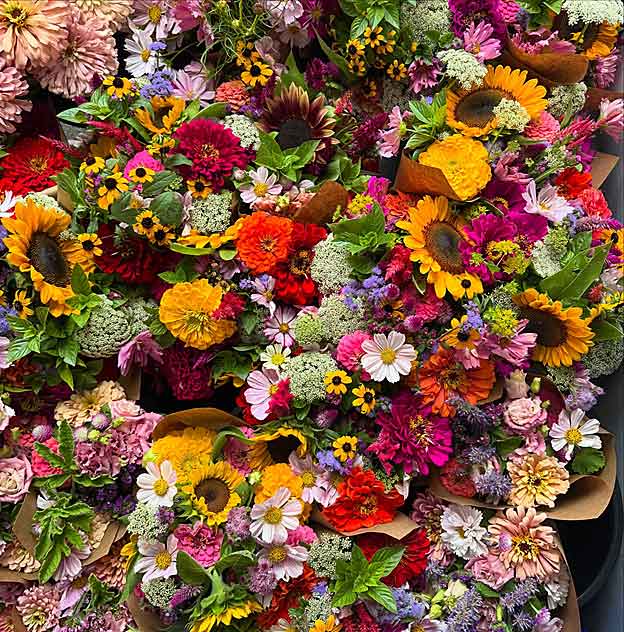
Our flowers have marked anniversaries, deaths, birthdays, weddings, business grand openings and even a very special wedding of two former interns, which took place here on the farm.
While much has changed on the farm since the early days, some things continue. Our flowers still attract a host of beneficial insects to the farm, providing nectar, seeds for food and habitat.
We still have some seeds from our flowers and grow them each season, bringing unusual forms and colors to our bouquets.
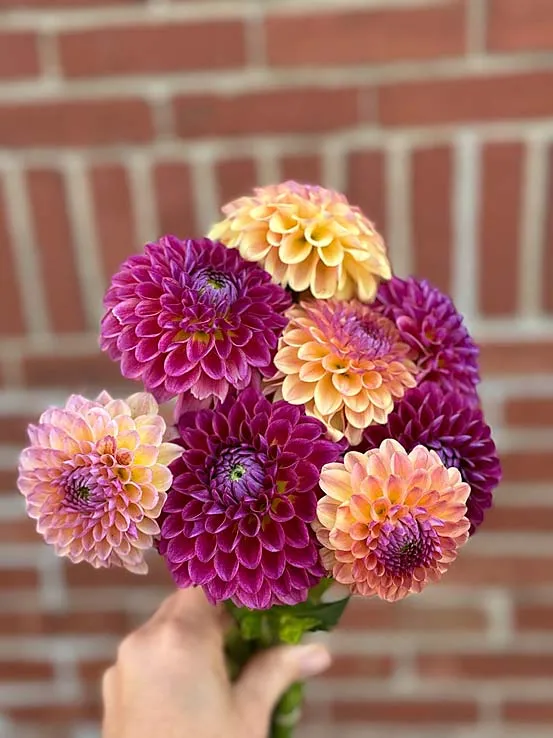
As time allows, I’ve even dabbled in a bit of dahlia hybridizing and we now have some of our own farm-bred dahlia varieties for sale at our annual plant sale each spring.
We can’t wait to see what the future brings!

Thanks for the history about the recent decades of flower growing at WVC, Candace! Thanks for your hard work and time. The flowers are beautiful!
What a wonderful history you have shared, Candace! Thank you for all you do and your and the team’s forward-thinking vision.
Candace, once again you make me so proud of you, how you operate, and what you produce. What a very lovely description of the history and beauty of our flower gardens. I think MTGuerin had a hand in bringing you to our new venture and being a pillar of WVC to this day! I love and appreciate you❣️