

Oral History: Sister Regina Marie McIntyre
“We are in a position, as musicians, to touch the souls of those who listen.” — Spencer W. Kimball
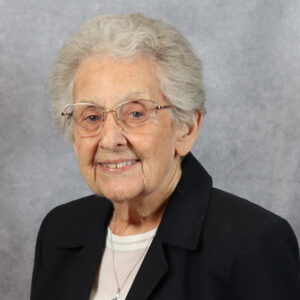
The future Sister Regina Marie McIntyre, then known as Marilyn, has been practicing music since age 12. She began piano lessons with Miss Esther DeBus in the Conservatory at the Star Piano Building in Richmond, Indiana, along with her sisters Patty, who also learned piano, and Rosemarie, who studied piano and cello.
Sister Regina Marie McIntyre went on to become the first woman organist and the first woman to have a seat in the choir at Saint Meinrad Archabbey since its founding in St. Meinrad, Indiana, in 1854.
The Archabbey is a Benedictine Monastery, home to 80 monks. These ‘firsts’ are a testament to Sister Regina’s gift of music, her spirituality, and the charism she carries as a Sister of Providence, following in the footsteps of Saint Mother Theodore Guerin who also established many ‘firsts.’
Sister Regina Marie was at Saint Meinrad on sabbatical to study theology and to practice the organ following 16 years as liturgist at Saint Mary-of-the-Woods Motherhouse.
While practicing at the majestic organ in the chapel at Saint Meinrad, the Abbot heard her playing. He approached her to be their organist.“I answered, ‘I am sorry, but I can’t do that as I don’t have the skill and repertoire needed.’ He kept asking me. I finally said yes.”
Saint Meinrad Abbey is one of Sister Regina Marie’s favorite ministries. She lived at the Abbey for 16 years, returning to Saint Mary-of-the-Woods Motherhouse every Sunday to Tuesday. Sister Regina Marie taught violin and cello to some of the monks. She has undying praise for the Monks at St. Meinrad and cherishes their wonderful hospitality and friendship to this day.
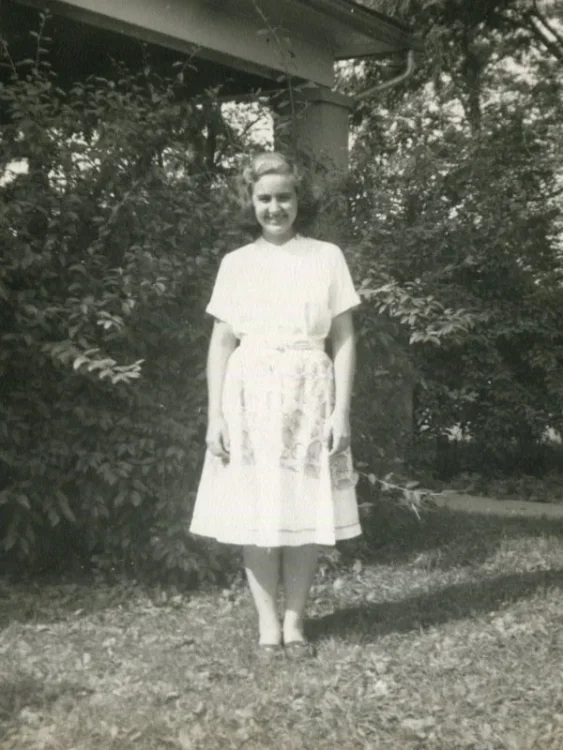
An Early Start in the Arts
Marilyn McIntyre was born in Eaton, Ohio, in 1931. She was the third child born to Robert and Edna Abley McIntyre. The McIntyre family moved to Richmond, Indiana, seven years later so the children could attend St. Mary’s elementary school there.
The oldest sibling, Margie, became an elementary school teacher who loved art. Bob was next, a veteran of the Korean War, who married and had children. Marilyn (Sister Regina Marie) was next; then Patty (later Sister Elaine), a Sister of Providence who taught elementary children. Finally, Rosemarie was born, who became a teacher, mother and an accomplished professional watercolor artist with her own salon. One child, Phyllis Ann, died in infancy.
“As to our garden and yard, we have all the woods. And the wilderness is our only cloister, for our house is like an oak tree planted there.” — Saint Mother Theodore Guerin
Immersed in Beauty
Nature embraced the McIntyre home in Richmond. There was a large, wooded area, and an estate with an arboretum. Nearby were the golf course and a public park. “We were immersed in this beauty. It was a great place to play and explore. We had a wonderful childhood in these surroundings, and we grew up appreciating God’s beauty and creation.”
That environment laid the foundation for Sister Regina Marie McIntyre and her sisters’ pull toward the arts throughout their lives.
Regina was born two years after the stock market crash, in a country still recovering from World War I and the Great Depression. It would soon enter World War II. Food was rationed – sugar, meat, eggs, milk – even shoe leather. Times were very difficult. Tragically, a year after the family moved to Richmond, their father, Robert McIntyre, died at the age of 39.
Early Hardship
Edna was suddenly a widow with five young children ages 2 to 11 years old at home and bills to pay. As Providence would have it, she had learned secretarial skills in high school from the Sisters of Providence at St. Mary’s in Richmond and was able to find a job quickly. Every day the children attended Mass with their mother; then she went to work while they headed to school. At the end of the day the children took the bus to the golf course and walked home from there.
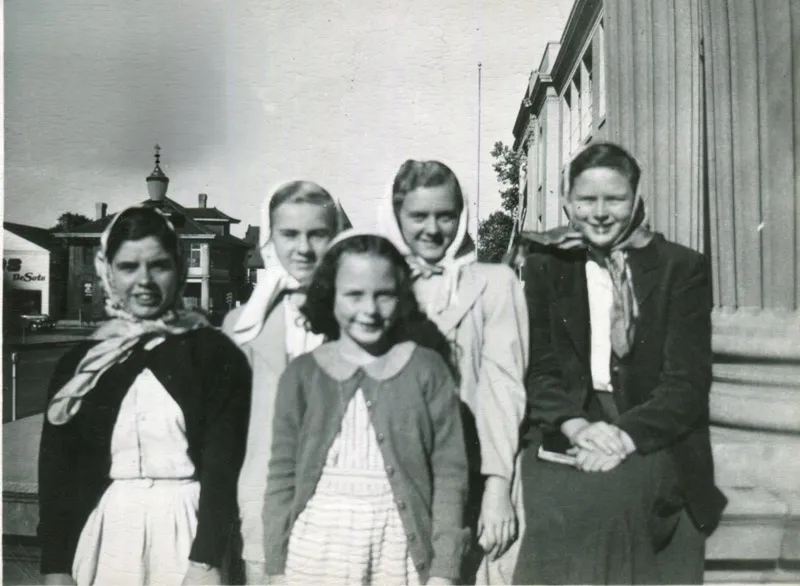
The McIntyres were latchkey children, who rushed to meet their mother every day when she arrived on the bus after work. A quiet but strong woman, Edna McIntyre carried on and did what was necessary to sustain them.
A Mother’s Deep Faith
She had brought the family to Richmond so the children would be in a Catholic school, and the children had Sisters of Providence as teachers just as their mother had.
Edna persevered, and in addition to daily Mass with her children she said the rosary with them at the dining room table each night. That influence was evident when each child seriously considered a religious vocation. Patty did become a Sister of Providence along with Regina Marie, and Margie entered the Sisters of Charity of Mount Saint Joseph in Cincinnati and left after several years.
Called
From the time she was in fourth grade, Regina Marie felt strongly that she would seek a religious vocation. She never wavered from that. Many of her teachers were Sisters of Providence whom she esteemed. Regina was particularly fond of Sister Rose Margaret (RIP), the choir director at St. Mary’s. “That time was probably the beginning of my formal prayer to include contemplation, and a way of being with God. It was probably the seed back then.”
Young Marilyn’s plan was to attend the Providence Juniorate at Saint Mary-of-the-Woods for high school. Those Sisters she had admired helped Regina prepare the things she would need to attend the Juniorate when she graduated from eighth grade.
Did her mother or any family member dissuade her from entering the order? Not her mother. “My Aunt Lucille would never say ‘no’, but she was helping me with everything and she just shook her head and said, ‘Marilyn, you’re just too young for all that black.’ But she was excited for me. That black meant something different to me than to Aunt Lucille. It meant I was becoming a Sister of Providence.”
At the high school Regina was immersed in music. That continued her freshman year at Saint Mary-of-the-Woods College.
“I practiced piano a lot. I was always in music classes. My classes were in the conservatory. I entered the Postulancy in January, and it lasted till August 15th, when I received the habit and became a Canonical novice. Canonical Novices cannot do formal studies. We had chores, picked fruit and cleaned areas in silence because we had the rule of silence. They were teaching us to be with prayer all the time.”
“Music expresses that which cannot be said and on which it is impossible to be silent.” — Victor Hugo
One of only a Few
Sister Regina Marie was one of only a few students in the Novitiate taking music lessons. As a student she played at the Cecilian Auditorium, once in a duet with another student.
She sang in the choir. Classes lasted until four o’clock, and then students could go for a walk together or read for an hour. She chose to practice during reading hour because there was little time for practice otherwise. Socialization and reading were sacrificed.
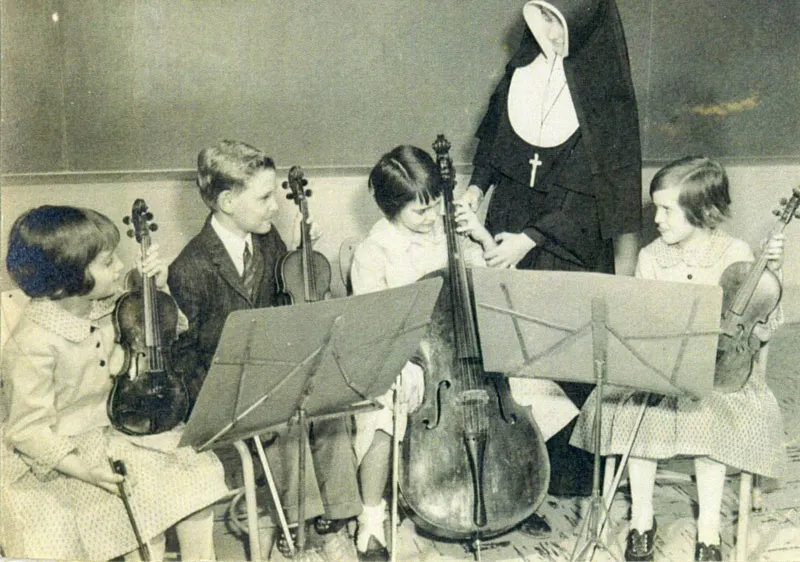
Sister Regina Marie earned a Bachelor of Science in Music from Saint Mary-of-the-Woods College. Her Master of Music degree is from Indiana University, where her thesis was a piano recital of classical music, 60 minutes long, played from memory.
She has a Certificate of Theology from The Catholic University of America. Sisters Regina Marie has studied with renowned musicians – piano, organ, violin. She studied with the learned Canadian organist and composer Conrad Bernier for two years.
She studied the Shinichi Suzuki method of teaching violin to all age groups of youngsters. Sister Regina Marie had the good fortune to attend Saint Mary-of-the-Woods when the late Sisters Cecilia Clare Bocard and Frances Angela Kolb were conducting choirs, playing the organ and composing.
“Love the children first, then team them.” — Saint Mother Theodore Guerin
The Ministry of Music
During her novice scholastic year, Sister Regina Marie replaced a teacher at St. Margaret Mary school in Terre Haute. It was there that Sister Regina Marie taught private lessons for the first time.
Sister Regina Marie’s first assigned mission was Ascension School in Halethorpe, Maryland. “We had to go by train. I was in the upper berth, and it rocked and rocked all night. The next day I was still rocking! Halethorpe was my first teaching experience. My students were all ages, and they came to me for private lessons. Music teachers are on their own. Luckily, a Sister from a neighboring convent came and helped me order music and get started.”
At the end of the school year, she planned a recital for students who had practiced piano all year. It is nerve-wracking for a teacher who knows a student may come out and shine or may come out on stage and cry.
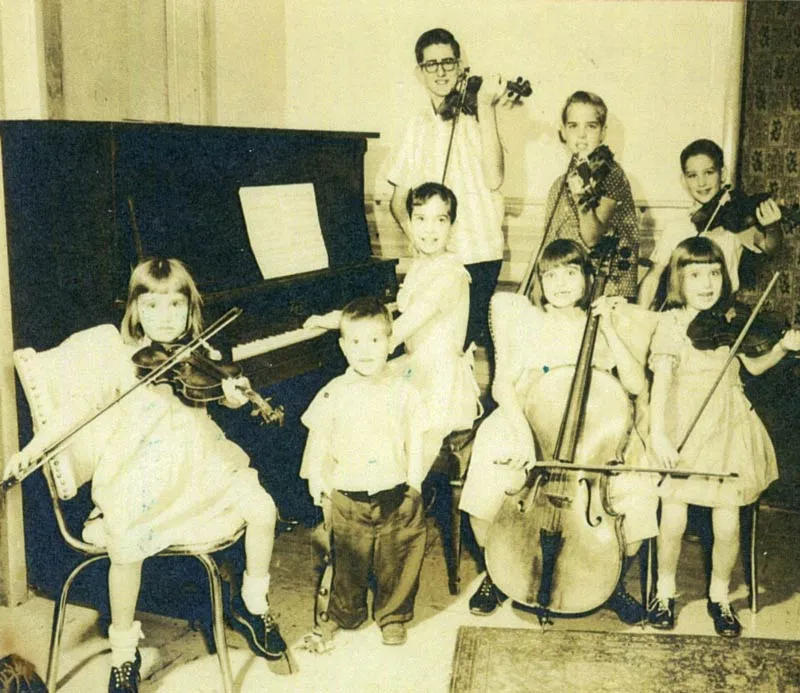
Recitals were presented with a theme, and for the recital at Halethorpe Sister Regina Marie decided to use the theme of the children’s story of ‘The Old Woman Who Lived in a Shoe’. The late Sister Anita Bechert helped Regina build the backdrop of a very large shoe made of cardboard fastened to a frame. They built and painted it in the basement of the convent. It looked fabulous when they finished it. And then they found they couldn’t get it out of the basement! It was too big for the door. A janitor came to the rescue.
Music and baton
After Halethorpe, Regina was in Chicago at Maternity of the Blessed Virgin Mary School (BVM). Her mother was ill and she needed to be closer to home. While at Maternity BVM she began teaching baton twirling. Sisters had received batons during the summer so they could become familiar with them and then offer lessons in their schools.
Batons were popular then, and the community always needed money. Even baton twirling classes had a recital. When parents paid for lessons, a recital was expected.
Her next assignment was Immaculate Conception in Tulsa, Oklahoma, where the desert, the windstorms and sand were quite an experience. Sister Regina Marie then took over a large music department at St. Philip Neri school in Indianapolis.
“Music is the language of the spirit.” — Kahlil Gibran
St. Charles in Bloomington
St. Charles school in Bloomington, Indiana, was Sister Regina Marie’s next assignment. “The people were very supportive at St. Charles. They were a go from the beginning. They had loving families and they were trying to be what the church was calling them to be.”
“I had a large music studio on the ground floor at St. Charles School. Children would come for lessons one-by-one. As they progressed, I developed group lessons to teach theory. Violinists had ensembles in addition to their private lessons. We developed a string orchestra. Sister Mary Florence (RIP) and I went to California for a workshop with Shinichi Suzuki. He stressed that when you work with children you must first love them. It is just as Mother Theodore said.”
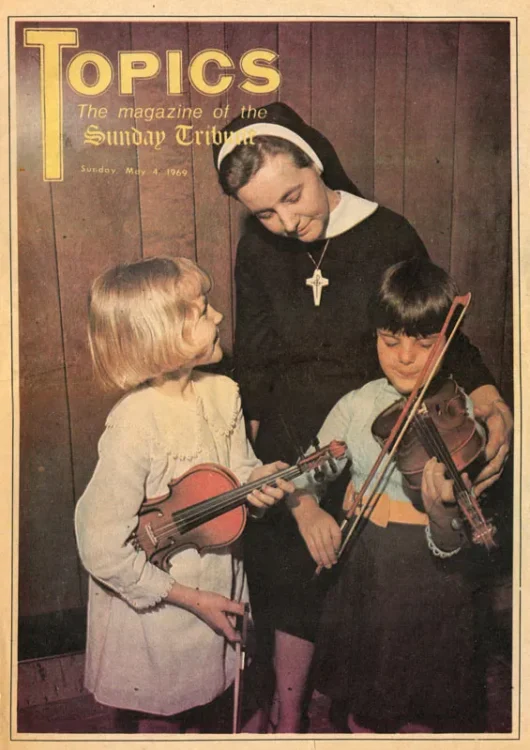
At St. Charles she taught violin to children as young as 3-years-old. She taught children ages 3 to 16 the piano, violin, cello, guitar and handbells. In 1979 Sister Regina Marie became the church’s choir director and liturgist while continuing to teach at the school.
Deep relationships
Regina worked with the cantors, the children’s choir, bell choir, began a folk group and started teaching guitar to the children. She also began formal organ lessons with Lois Pardue.
For 26 years, the children at St. Charles School in Bloomington took lessons and learned the piano, cello, violin, handbells, guitar, theory and the love of music from Sister Regina Marie.
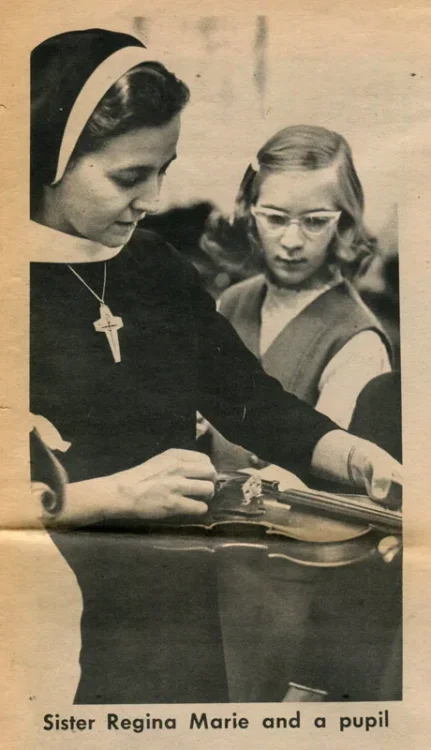
She was honored at her Silver Jubilee by hundreds of her students, former students, parents, parish members and friends attending or sending well wishes. Without a doubt, St. Charles is one of her very favorite missions.
Always learning
A sabbatical to study at The Catholic University of America in Washington D.C. followed her retirement from St. Charles. That was where she had the opportunity to study with the famed Conrad Bernier. She stayed for two years, studied, worked as a receptionist at Dunblane School, and continued lessons with Bernier.
Even as a young child Regina Marie was fascinated by the organ in the church in Richmond. “I like the organ. I’m intrigued by it and its challenge. I love the violin and its soulful sound. And the piano is dashing and daring.”
“There must be always remaining in every life, some place for the singing of angels, some place for that which in itself is breathless and beautiful.” — Howard Thurman
Liturgy Changes
Sister Regina returned to the Motherhouse at Saint Mary-of-the-Woods as Director of Liturgy, Organist, Choir Director and Pianist in 1982. “Following Vatican II we were making liturgical changes. Liturgies became more meaningful, They were in English and they were more active. We were participating more in worship. The late Father Bernie Head understood the changes. He helped us through it. The church was totally renovated during those years. Many statues were removed, the floor was replaced, the depictions of the Way of the Cross were simplified. The current altar and chair were part of the original altar.
“The Linden tree that Mother Theodore had planted had blown down in a storm. Sister Rita Ann Roethele (RIP) took it to ISU to an artist there who fashioned our current processional cross out of that tree. Major work was also done on the organ during those years. I had people helping me. Sisters Rita Roethele and Ruth Johnson managed the flowers and symbols we were using. We did all the liturgy schedules and assignments by hand until we found a computer program that would put it together.
“Our group found different places to have liturgy during the renovation, usually at Owens Hall every day at 4 p.m. We were changing from singing chants to more contemporary music. I was also responsible for funerals and wakes. I don’t how I did it, but I loved it.”
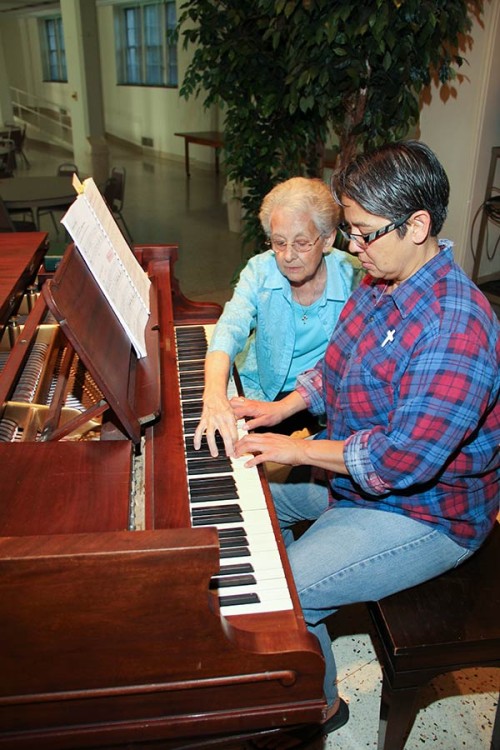
Beauty
The changes in liturgy following Vatican II were dramatic. Those changes, coupled with the spirituality of liturgists like Sister Regina Marie and their committees, resulted in planning the celebration of Mass in ways to engage the assembly and enhance their worship experience. It was a task not to be underestimated. It was an exciting time coupled with a lot of work and learning.
Sister Regina Marie was liturgist at the Motherhouse at Saint Mary-of-the-Woods for 18 years. It is also a favorite ministry. During those years she lived at Nazareth house nearby. Flowers surrounded her home and filled the rooms, reminiscent of those childhood days encircled by the beauty God had provided. She made dry flower arrangements. She has always been good with her hands, perhaps not unusual for a pianist/organist. When she did retire, she volunteered as a gardener of the grounds at the Woods with Sister Mary Morley.
Travel
Sister Regina Marie has traveled throughout the world. When she was in Bloomington she traveled to Germany and discovered organ recitals were played every day at noon in a small town. She remembers Dachau and the unbelievable sadness as well as the reminder that Christians have a responsibility to spread goodness. Sister has been to Austria, Newfoundland, Rome, France, Switzerland, the Cayman Islands and many states. She visited the Holy Land and considers it the most meaningful and memorable of all the trips she has taken.
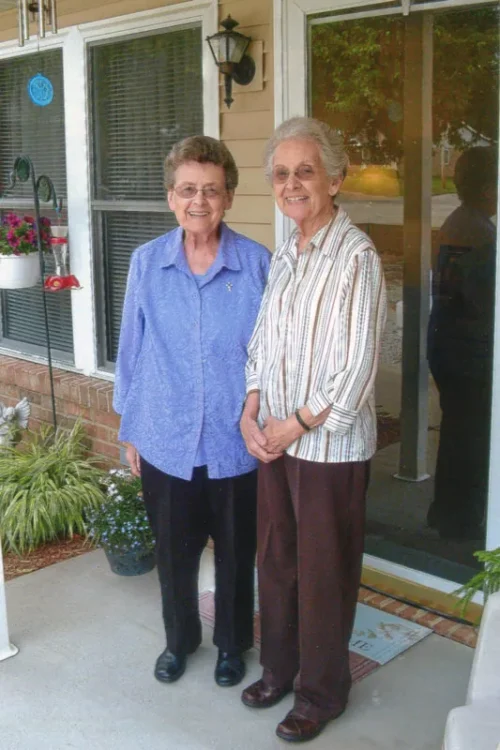
Rome was a very special trip. She and Sisters Jan Craven and Paula Damiano created the liturgy for the Beatification of Mother Theodore Guerin. For the Sisters who stayed at the Woods, she prepared the group to celebrate the same liturgy at home that was being celebrated in Rome. It was busy! Because there was so much to do in Rome, Sister Regina Marie did not go on the tour that others were taking, but for her Golden Jubilee she made the same tour two years later with Sisters Patty, Rita Black (RIP), and Suzanne Buthod (RIP). It was wonderful! They toured France, Brittany and Etables, Ruille and Petit Providence, Switzerland, Etables’, Notre Dame and Mont-Saint-Michel.
A Love for all Ministries
“I play the notes as they are written, but it is God who makes the music.” — Johann Sebastian Bach
Sister Regina Marie favors the thoughtful composition of classical music. Loss of hearing has become a challenge. “Sometimes when I think of a piece of music, I hear it in my head.”
“My ministries have all been challenging and equally satisfying. I have loved each one. The linking thread through them all has been music … music and the love you bring to others. St. Charles in Bloomington was filled with music and the love of the people there. At St. Meinrad Archabbey, I learned about the monastic life; Monks pray all day, pray and work. The theme came through there also, music and love. My first time Saint Mary-of-the-Woods as liturgist it was all about renewal and love, and music came through this. I am a forward-thinking person. I have wonderful memories and wonderful friends from over the years who stay in contact with me.”
Retirement
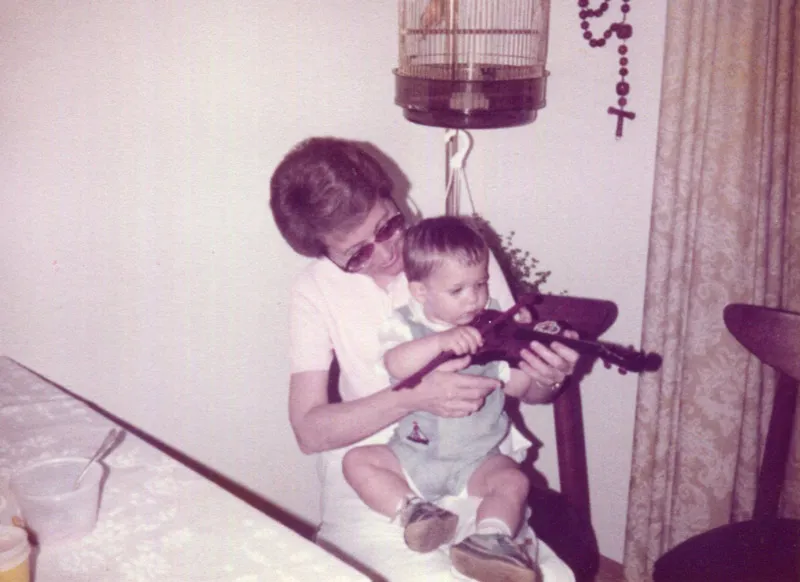
When Sister Regina Marie returned to the Woods in retirement, she still played for Mass for Saint Mary’s Village Church in St. Mary-of-the-Woods, Indiana.
She volunteered at the Wabash Valley Healthcare, the Providence Food Pantry, and The Helping Hands, outreach ministry. Sister Regina Marie has taken part in witness events for love, mercy and justice. She continues as a receptionist once a week at the Administration Building. She also works with canonical novices with liturgical music and singing.
Changes
“When you look around at what Saint Mother Theodore Guerin and her companions started here, it is amazing!” — Sister Regina Marie McIntyre
Sister Regina Marie McIntyre entered the novitiate with 32 people in her band. Now there are two. Back then the church balcony would be filled with choirs singing, directed by the late Sisters Frances Angela and Cecilia Clare Bocard, and later by Sister Regina Marie.
She wore the habit a little longer than some in the Order because at that time she was halfway through classes at Indiana University, and this introvert was not suddenly going into class one day without the habit and with a different name.
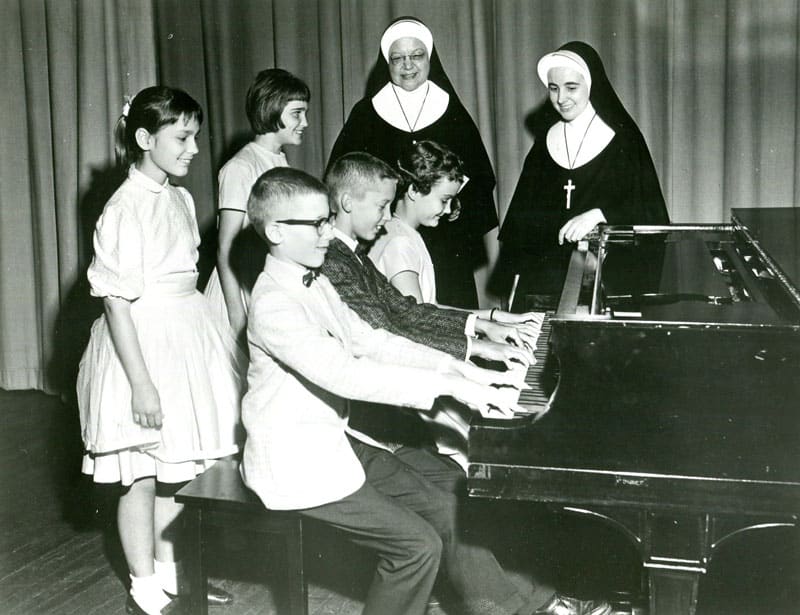
Until very recently, Sister Regina Marie would rise very early each morning, spend considerable time in prayer and then would go to the church where she practiced the organ every day.
That was her daily routine for 10 years. She no longer takes the 39 stairs to the organ loft from the narthex of the church. Those of us who don’t play the organ can only marvel at the majestic power that emanates from it in our liturgy, our celebrations and the dedication of those who master it.
‘Pray. Be Open.’
Does she have advice for someone considering a religious vocation? “Pray. Be open. Have the desire to live a life dedicated to God, and to being God’s presence in the world.” Her own personal sanctuary for prayer is in her room where she can look out the windows and admire the beauty God has given to us or look into the dark sky and stars.
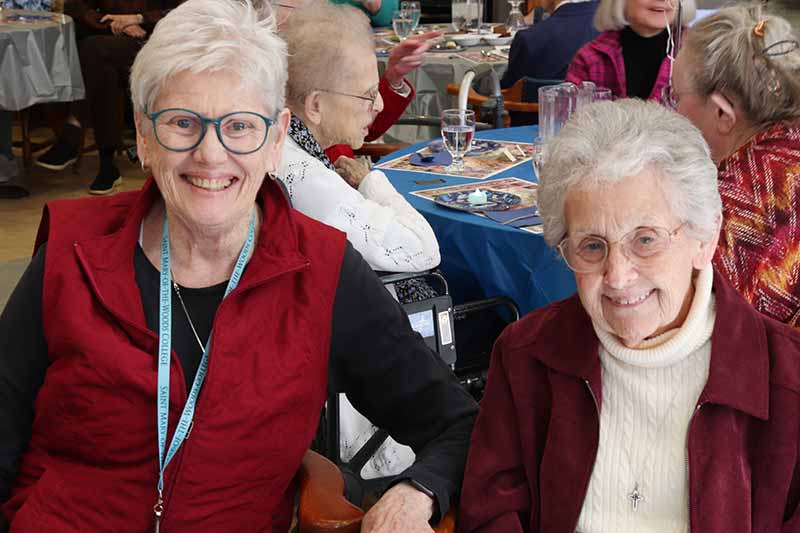
The Blessed Sacrament Chapel is a very sacred place for her, as well as being outside in nature, no doubt a carryover from a childhood surrounded by the beauty of the outdoors. The Eucharistic liturgy and the contemplation she began to practice in elementary school are most important in her spiritual life. “May the Christ in me see the Christ in you and may the Christ in you see the Christ in me,” are her words of wisdom.
Stories to tell
Sister Regina Marie is a delight to talk with, a humble, deeply spiritual woman who laughs easily at herself. Ask about her photos from every trip and mission, or that recital at Halethorpe, or how you teach violin to 3-year-olds.
She can tell you about her encounter with the then 6-year-old Joshua Bell, now a celebrated violinist and conductor. Sister Regina Marie has a story to tell about that baton recital at Maternity BVM.
She can also talk about that train stop platform across from the Saint Mary-of-the-Woods entry gate and how exciting it was every summer to come back to the Woods. “We would get off the train and come on over to the avenue. We would all be lining the walks, a flood of Sisters would be coming down the avenue, so excited to see their friends again.”
Claiming the Legacy
Like Saint Mother Theodore Guerin, Regina has known from childhood that she wanted to be a Sister of Providence. She has claimed Mother Theodore’s legacy and the charism of Providence, manifested in love, mercy and justice.
Regina has passed fire and flame to countless others through music. She has a cadre of professional, accomplished students who stay in touch with her — students who have performed at Carnegie Hall and the Kennedy Center, won the Governor’s Award, founded their own schools of music, and gone on to teach and share the music she helped kindle in them.
Sister Regina Marie has loosed the energy of the sounds of music into the air around us her entire life, through her own God-given talent and, in turn, the talents of her students — music that is familiar, that comforts, that excites, that is magnificent.
Regina Marie is humble and hopes she is remembered as a good, loving person who inspired others. I will remember her as the musician who sees Christ in everyone.
Thank you Debby for the beautiful summary of Sister Regina Marie’s life as a SP and musician/teacher. What an inspiration!
Glory to God for a life so well lived, dear Sister Regina Marie, SP.
Thank you for setting example after example of faithfulness to God’s calling in your life.
As a music teacher myself, I’m blessed by the ripples that go forth in being who God has created us to be.
God bless you!
I was fortunate to meet Sister Regina Marie at the recent Annual Meeting! Thank you Debbie! Getting to know the Sisters of Providence, whether in person, or in reading such a thorough article about their life is a precious gift. It helps me ‘lean on Providence’ as we Associates do our best to be Charism partners to the Sisters. The Sisters will always lead the way for us!