

That very day, the first day of the week, two of Jesus’ disciples were going to a village seven miles from Jerusalem called Emmaus, and they were conversing about all the things that had occurred. And it happened that while they were conversing and debating, Jesus himself drew near and walked with them, but their eyes were prevented from recognizing him.
He asked them, “What are you discussing as you walk along?” They stopped, looking downcast. One of them, named Cleopas, said to him in reply, “Are you the only visitor to Jerusalem who does not know of the things that have taken place there in these days?” He replied to them, “What sort of things?” They said to him, “The things that happened to Jesus the Nazarene, who was a prophet mighty in deed and word before God and all the people, how our chief priests and rulers both handed him over to a sentence of death and crucified him. But we were hoping that he would be the one to redeem Israel; and besides all this, it is now the third day since this took place. Some women from our group, however, have astounded us: they were at the tomb early in the morning and did not find his body; they came back and reported that they had indeed seen a vision of angels who announced that he was alive. Then some of those with us went to the tomb and found things just as the women had described, but him they did not see.”
And he said to them, “Oh, how foolish you are! How slow of heart to believe all that the prophets spoke! Was it not necessary that the Christ should suffer these things and enter into his glory?” Then beginning with Moses and all the prophets, he interpreted to them what referred to him in all the Scriptures. As they approached the village to which they were going, he gave the impression that he was going on farther.
But they urged him, “Stay with us, for it is nearly evening and the day is almost over.” So he went in to stay with them. And it happened that, while he was with them at table, he took bread, said the blessing, broke it, and gave it to them. With that their eyes were opened and they recognized him, but he vanished from their sight. Then they said to each other, “Were not our hearts burning within us while he spoke to us on the way and opened the Scriptures to us?” So they set out at once and returned to Jerusalem where they found gathered together the eleven and those with them who were saying, “The Lord has truly been raised and has appeared to Simon!” Then the two recounted what had taken place on the way and how he was made known to them in the breaking of bread.
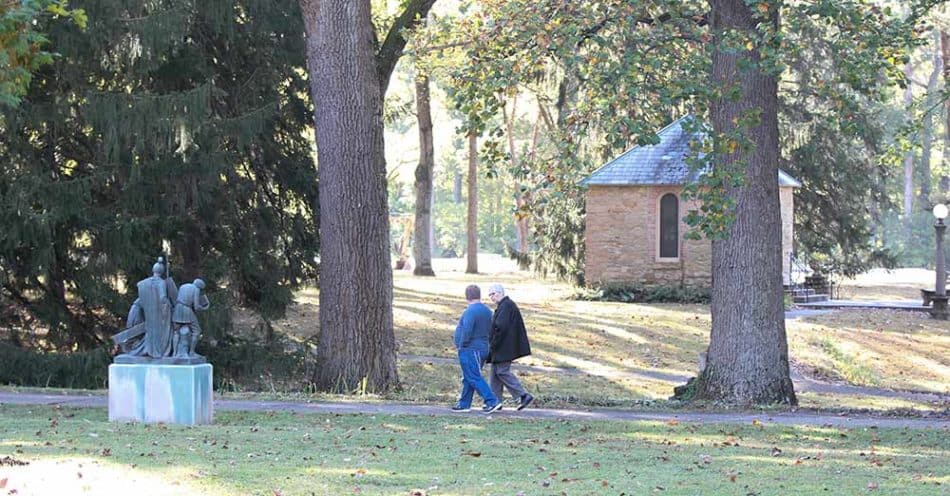
Two of Jesus’ disciples walk the seven miles between Jerusalem and Emmaus. As they walk, they are “conversing and debating about all the things that had occurred.” As they walk and talk “Jesus himself drew near and walked with them but their eyes were prevented from recognizing him.” What prevented them from recognizing Jesus? After all they experienced Jesus “as a prophet mighty in deed and word before God and all the people.” In their hearts they and many others hoped Jesus “would be the one to redeem Israel.” Obviously, they had seen Jesus in action and heard his words many times and were impacted by them. So how could they not know it was Jesus who drew near to them?
This observation attributed to both Anais Nin and C.S. Lewis may shed some light. “We don’t see things as they are. We see things as we are.”
How were these two followers of Jesus “seeing things” as they walked? Just some guesses: confused; discouraged; deprived of hope; sad if not depressed; foolish for trusting Jesus would free the people.
They were aghast at what their fellow traveler didn’t know: “Are you the only visitor to Jerusalem who does not know of the things that have taken place there in those days?” Cleopas, one of the two relates all that happened. Jesus’ curt reply may have taken them aback. “Oh how foolish you are! How slow of heart to believe all that the prophets spoke!”
Sharp words! A rebuke! Yet they do not draw away from him. They listen attentively. They are so intrigued they invite him to stay with them; share a meal with them. They recognize Jesus “in the breaking of the bread.” As soon as they “see things as they are” Jesus vanishes. Even so, the two can’t deny that Jesus made himself known to them. They recognized him in his words and in his actions. Now they saw “things as they are.”
Happy ending, right? Isn’t it possible that they, like us, kept falling into the trap of “not seeing things as they are but as (we) are?” Isn’t it possible that our hearts aren’t always burning within us as we read or hear the Scriptures? Isn’t it possible that we say “Amen” to the Body of Christ out of habit? Of course, all those things can be true. And yet … and yet … it is also possible that we have so many moments of seeing “things as they are, not as we are.” Very possible and very likely because “two things can be true at the same time.”
Write/print (not type) 5 times: Two things can be true at the same time.
Write/print (not type) 5 times: We don’t see things as they are, but as we are.



Guilty as charged! Too many times to count I have experienced Jesus’ touch clearly weeks, months, and even years later. I try to walk with the Holy Spirit every day…not only with my eyes wide open but also with my ears!
Thank you Sister Denise. So much here to reflect on and live into.