Note: The following piece was co-authored by Providence Associates Jane Fischer and Dr. Pearlette Springer as part of the 30th JUSTus Podcast.
In Pope Francis’ encyclical letter, Laudato Si’, the first line reads “… our common home is like a sister with whom we share our life and a beautiful mother who opens her arms to embrace us.” Later in line 11, he says, “that an integral ecology calls for openness to categories which transcend the language of mathematics and biology, and take us to the heart of what it is to be human.” For many years, we believed that ecology, nature, animals, rivers, lakes, streams and oceans were independent parts of creation. Pope Leo, picking up where Pope Francis left off, writes that Integral Ecology “focuses on care for the natural environment and all people, as well as broader questions of the relationship between God, humans, and the Earth.”

Integral Ecology centers on relationships—it is about caring for all creation and being aware of and engaged with human beings and nature.
The Cries of the Earth and the Cries of the Poor:
In LAUDATO SI’, Pope Leo writes of “the cries of the earth and the cries of the poor.” As evidence, Network Lobby reports that the current Environmental Protection Agency “will no longer factor the value of lives lost or worsening asthma or heart disease when calculating the costs of air pollution. The agency has said it will instead focus on the economic costs to industry.” This is one small example where intersectionality with components such as health care, food, shelter, and clothing will be separated and hidden from human creation.
St. Francis of Assisi, in the Canticle of the Creatures, writes “Praised be you, my Lord, with all your creatures, especially Sir Brother Sun … Sister Moon and the stars … Brother Wind … Sister Water … Brother Fire … and Sister Mother Earth … Praised be You, my Lord, through those who give pardon …and Sister Bodily Death from whom no one living can escape.” In this poetic chant, St. Francis lays the groundwork for acknowledging that all of Creation is connected. As humans, we do not sit apart from the Sun, the Moon, and the stars, the Wind, or any part of creation, regardless of size, power or location. In fact, many forms of life affect us in ways most of us are not even aware of.
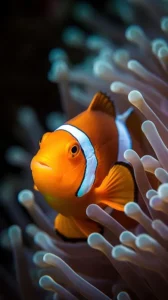
For example, “On January 13, 2025, an iceberg the size of Chicago, named A-84, broke away from the George VI Ice Shelf, one of the massive floating glaciers attached to the Antarctic Peninsula ice sheet,” and on January 25, a team disovered “A large sponge, a cluster of anemones, and other life is seen nearly 230 meters deep at an area of the seabed that was very recently covered by the George VI Ice Shelf, a floating glacier in Antarctica. Sponges can grow very slowly, sometimes less than two centimeters a year. The size of this specimen suggests this community has been active for decades, perhaps even hundreds of years.
Neil deGrasse Tyson, astrophysicist and director of the Hayden Planetarium, posted on Facebook on May 8, 2025, “Pope Leo XIV encourages scientists to consider the ethical dimensions of their work and to ensure that technological advancements promote human dignity. Francis also highlighted the importance of addressing environmental issues, advocating for urgent action against climate change and promoting sustainable development. Given Pope Leo XIV’s alignment with Francis’ inclusive vision and his support for environmental sustainability, it is anticipated that he will continue to uphold the Church’s commitment to integrating scientific understanding with ethical and theological considerations.”
So … How do we change the world?

First, let’s look at the numbers. According to Zenit, there are 1,422 billion Catholics on this planet. If each one of us touched just one other person, worldwide metanoia would happen overnight.
Second, consider connecting with the work of the International Union for Conservation of Nature and the Nature Conservancy. The International Union for Conservation of Nature is a membership organization of government and civil agencies. They work together to advance sustainable development, with the goal of creating a just, values-based world while conserving nature. The Nature Conservancy works in all 50 states and in Africa, Asia Pacific, Canada, the Caribbean, Europe, India, and Latin America. The TNC works with public and private partners to ensure the lands and waters are protected for generations to come.
(NOTE: Except for Catholics, the other groups listed do not currently follow the idea of “Integral Ecology.” We have a lot of work to do! Looking at this table, it is clear that we, as Catholics, need to do two things: learn about Integral Ecology ourselves and share our beliefs and knowledge with others. OpenAI)
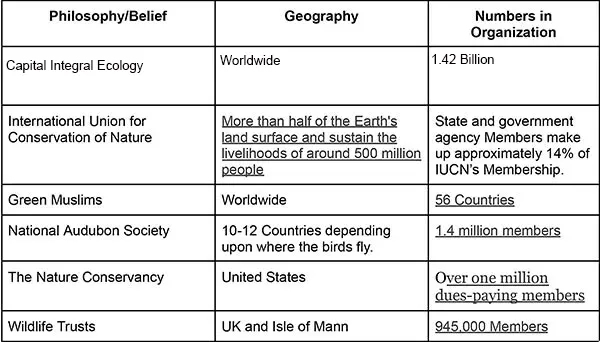
(Download a PDF of the above graphic, which includes additional links, here).
On Oct. 4, 2023, Pope Francis released his Apostolic Exhortation, Laudate Deum, as a direct, highly focused addendum to his 2015 encyclical Laudato si’. While Laudato si’ laid the broad philosophical and theological groundwork for integral ecology, Laudate Deum serves as an urgent, sharply worded warning that global progress has been entirely inadequate and the world is nearing a dangerous “breaking point”. ”If Laudato Si’ was a gentle and pastoral invitation to care for creation, Laudate Deum is a visceral, prophetic call to conversion.”
As stated by our Catholic Bishops, “We show our respect for the Creator by our stewardship of creation. We are called to protect people and the planet, living our faith in relationship with all of God’s creation. This environmental challenge has fundamental moral and ethical dimensions that cannot be ignored
Write these down and keep them nearby. Ask yourself. Then ask your friends.