The Prayer of a righteous person is powerful and effective.”
James 5:16
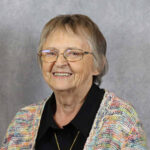
Sister Maria Smith rises very early each morning ready for the day. Right away she prays the Memorare.
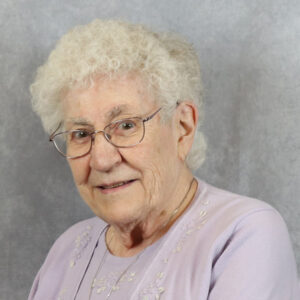
Maria, born Catherine Mae Smith, has been devoted to Our Lady of Providence all her life, taking Mary as her chosen name at First Communion.
Her mother had explained that her given name Mae meant ‘Mary;’ but Catherine Mae insisted, so the Sister of Providence in charge of First Communion told her she could be Catherine Mae Mary.
Following the Memorare prayer, Sister Maria sews nametags, hems pants, or mends some item of clothing that someone has brought to her. Raised by a mother who was an excellent seamstress, Maria did not learn to sew at home and recalls once telling a Sister who assigned her to the sewing room, “Oh, Sister, I don’t know how to sew.”
That Sister promised Maria that she would learn, and she did. She helped make habits in the sewing room and eventually taught others.
Although she can no longer use a sewing machine, she stays busy altering clothing for others, a time of quiet meditation so early in the morning. “I can’t do a lot of things. I can sew, and I want to be helpful. They are all so grateful.”
Sister Maria’s morning routine takes her to the Blessed Sacrament Chapel next, where she prays the rosary and two prayers always available in the Chapel. It is her favorite place on the grounds.
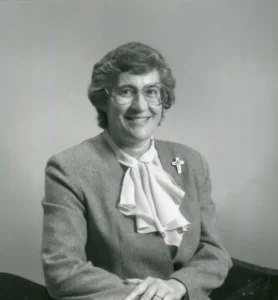
Mass follows. Sister Maria, the former Sister Maria Goretti, has a lifelong dedication to God and to her community. She brings love, mercy and justice to everyone whose path crosses hers and who need what God requires of us.
Maria knew in third grade that she would become a Sister of Providence. Like many, many third graders she fell in love with her third-grade teacher Sister Bernadetta.
Maria was always the teacher when they played school at home, modeling Sister Bernadetta’s walk and style of teaching, a style she continued many years later as a first-grade teacher.
A love of teaching and a future Sister of Providence was cultivated in that third-grade classroom at St. Mary’s Elementary School in Lafayette, Indiana, bolstered by the foundation laid by Maria’s devout and loving parents.
Life on a farm is a school in patience; you can’t hurry the crops or make an ox in two days.
Henry Alain
Raised on a working farm in Tippecanoe County, Indiana, Sister Maria was born when the Great Depression was winding down, and World War II was ramping up.
Her parents were Carl and Bertha Bratz Smith, descendants of four German brothers who had come to Indiana, with one of them settling in Lafayette. Her childhood home sheltered two adults and 14 children – nine girls and five boys: Mary, Betty, Bill, Jean, Dorothy, Cecelia, Don, Ricky, Alice, Rosemarie, Catherine Mae (Sister Maria), Bernadette, Bob, and Charlie, all gone now except Maria. Her siblings called her ‘Cacky.’
On the farm the boys were expected to help their dad, while the girls took care of the house as their mother was busy making dresses from feed sacks for nine girls.
None of the girls owned a store-bought dress until they left home. Bertha would travel to the feed store when the shipment of feed arrived to choose the prints she wanted, and the owner would put the sacks aside until money was available to purchase them.
“Everyone else at school had store-bought dresses,” Maria said. “It surprised me when one of the Sisters who taught at St. Mary’s told me later that the girls at school were envious of the Smith girls’ dresses. But my mother always added a little lace or something to dress up our dresses when she made them.”
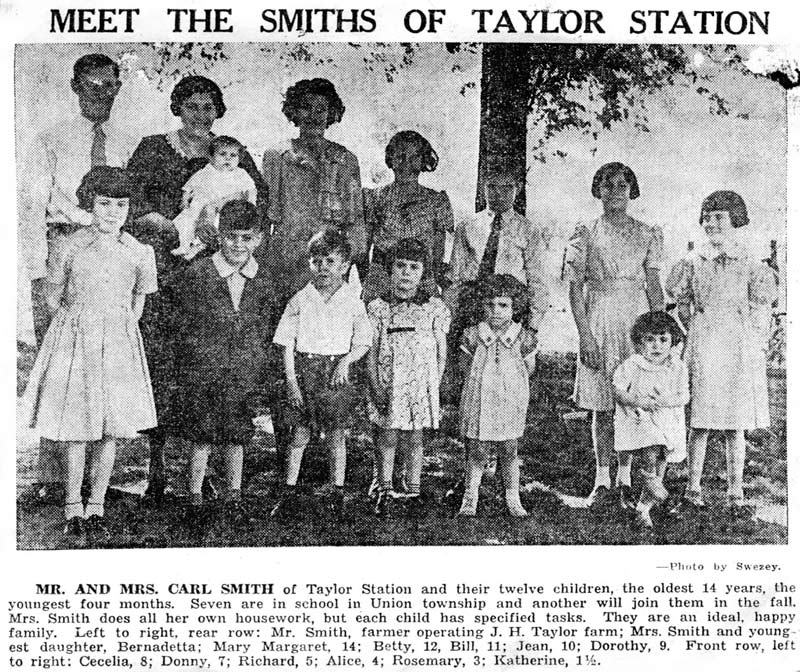
“My mother was a saint,” Maria told me. While Bertha sewed, the girls cleaned and cooked. From a young age the Smith girls could keep a house and put a meal on the table. Maria and her sisters also had a large garden during summer and canned produce from it so there would be food throughout the winter.
With only a second-grade education Bertha organized a household of 16 people, taught her daughters to do the same, sewed all their clothes, cut all their hair, and never raised her voice.
The Smiths were poor like many people recovering from the Great Depression. They had a farm and livestock, but life was a challenge. A hand pump delivered water into the house for drinking, cooking, laundry, and bathing. They cooked on a wood cook stove.
They heated water with wood, heated the house with wood. There was no refrigerator, just an icebox that kept things cold as long as the ice lasted. Every Sunday after Mass they stopped at the icehouse to get a large block of ice. They took turns chipping on it for ice cream in the summer; but when the ice was gone it was gone until the following Sunday.
The Smiths raised cows, pigs, sheep, and chickens. They butchered and smoked their own meat and hung it beneath the stairs for storage.
After school everyone had a chore, then supper, dishes, homework. The children sat at the table for homework, and if they didn’t have any, they sat and read a book they brought home from school.
After homework the children knelt to say the rosary for their nighttime prayers and then went to bed. The only time to play was on the weekends and during the summer.
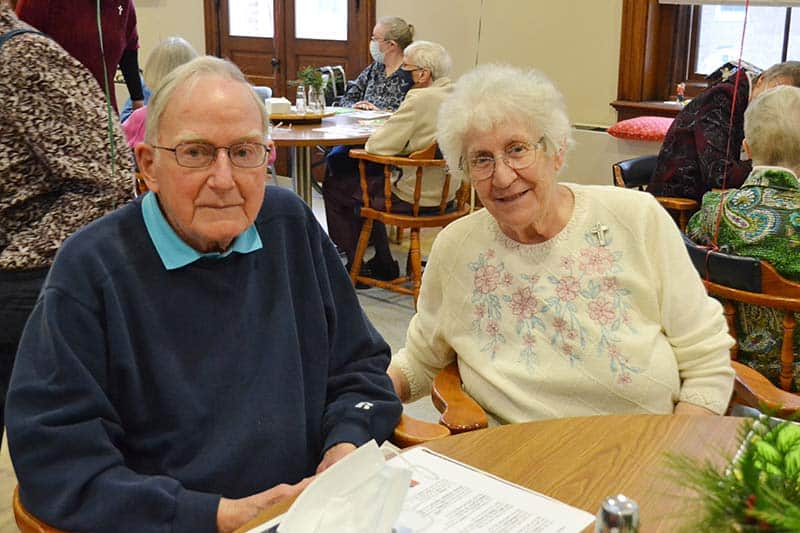
They played baseball that their dad refereed; they skipped rope and played outside games that children normally play. Inside the only toys were table jacks and imagination.
The older children went to work to help the family after graduation. Although there was no money for toys, and no money for books, Maria said, “We never felt we were poor when we were growing up.”
Every Saturday when Carl and Bertha drove to the grocery for staples like sugar and flour that they couldn’t grow at home, they delivered eggs to the Sisters of Providence and to the Carmelite Sisters; frequently they took chickens to the Sisters that Bertha had dressed for them.
The unconditional love and appreciation for life born in that farmhouse, the foundation laid by Carl and Bertha, gave Sister Maria the gift of a spiritual generosity that she has shared with countless others.
Put yourself gently into the hands of Providence.”
Saint Mother Theodore Guerin
Maria came to Providence Juniorate High School at Saint Mary-of-the-Woods after eighth grade. Her older sister Cecilia was already there. Her sister Rosie, older but more introverted than Maria, had told their mother that she wanted to be a Carmelite Sister, but when Bertha said, “Did you know Cacky wants to be a Sister of Providence?” Rosie decided to go with Maria. Always outgoing, Maria said she often had to drag Rosie along with her to do things.
A younger sister, Bernadette, followed them to the Juniorate. At one time there were four Smith girls at the Woods, and all of them became vowed Sisters of Providence.
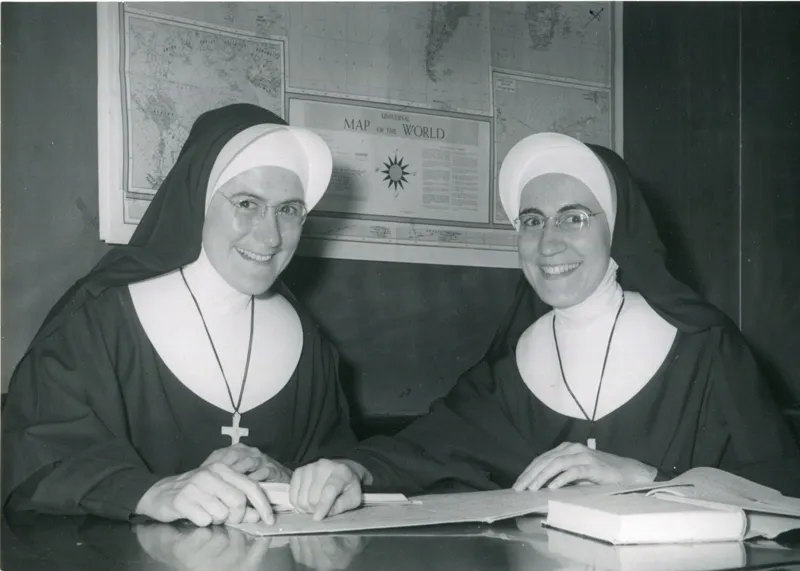
“Coming to the Juniorate was totally different,” Maria said. “It took me a long time to get used to going into a bathroom, and to turning on the water. And it was the first time I had slept in a bed by myself.”
Maria’s parents were supportive when Maria entered the Novitiate straight from high school. Two years later she was on an overnight train to Oklahoma City to teach first grade at Corpus Christi Elementary.
“I had never been away from home or St. Mary-of-the-Woods. I thought I was going to the end of the world! Oh my gosh, I was scared. It was awful. And it was the first time I ate in a restaurant when we ate in the dining car on the train. They showed me the menu and I said, ‘you expect me to read this?’ I told another Sister to just order me something. She ordered me a whole platter of shrimp. I said, ‘Oh, I can’t eat that, help yourself’. I never ate shrimp that night or since then.”
Corpus Christi Elementary in Oklahoma City was the beginning of Maria’s 25 years as a first-grade teacher. It was also the first time she taught music to her classroom.
When the late Sister Mary Lourdes had told her students at the Woods they would be teaching music, Maria had approached her afterward to say, “Sister, I won’t be able to do that.” Thereply: everyone teaches their own music. “Sister, I’ll try. So every day in my classroom at the end of the day when we had music, I did what I thought we were supposed to do. I had a pitchpipe. I blew the pitch, then hummed the pitch, then we sang the song. So, who comes for visitation? Sister Mary Lourdes. She came to my classroom. I was so proud of my little ones. I blew the pitchpipe; we hummed the pitch and sang the song. When we were finished Sister came right up to my face and asked, ‘Sister, how did you do that?’ and I said I don’t know. She said, ‘I don’t know either. You blew one pitch, you hummed a different pitch, and you started the song on a different pitch. I now believe you when you told me you can’t do that. You need some help.’ She sent me tapes and a tape recorder.”
Besides Oklahoma City, Maria taught at St. Sylvester in Chicago, followed by Indiana schools: St. Mary in Richmond, St. Ann and St. Simon in Indianapolis, St. Mary in Lafayette, and St. Patrick in Terre Haute. One year she had 64 students in her first-grade classroom. Maria earned a Bachelor of Education degree from Saint Mary-of-the-Woods College and a Master of Education from Indiana University.
Each activity of daily life in which we stretch ourselves on behalf of others is a prayer in action.”
Richard J. Foster
At the end of twenty-five years Sister Maria was ready to leave the profession she had loved dearly and to follow wherever Providence was leading her to use her gifts.
Vatican II had encouraged religious communities to embrace their local communities and to promote justice, peace and human dignity, to become more contemporary and engaged with the modern world.
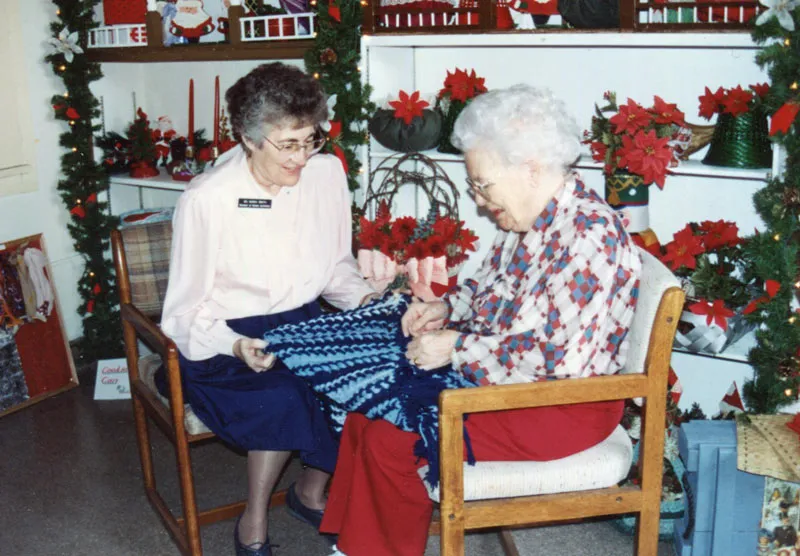
The habit gradually disappeared although Maria was one of the last to give it up; she had no quarrel with giving it up, she just loved the habit. She went south to New Albany. St. Edward Hospital had been remodeled into Providence Retirement Home, managed by the Sisters of Providence, and they needed an Activity Director. Maria answered that call and lived and worked for 13 years at Providence Retirement Home providing activities for residents on each floor.
We empty ourselves to make the lives of others matter.”
Sister Joan Chittister, OSB
In 1994 Providence Self-Sufficiency Ministries was founded to address the needs of abused and neglected children and to provide services to public housing in New Albany and Floyd County.
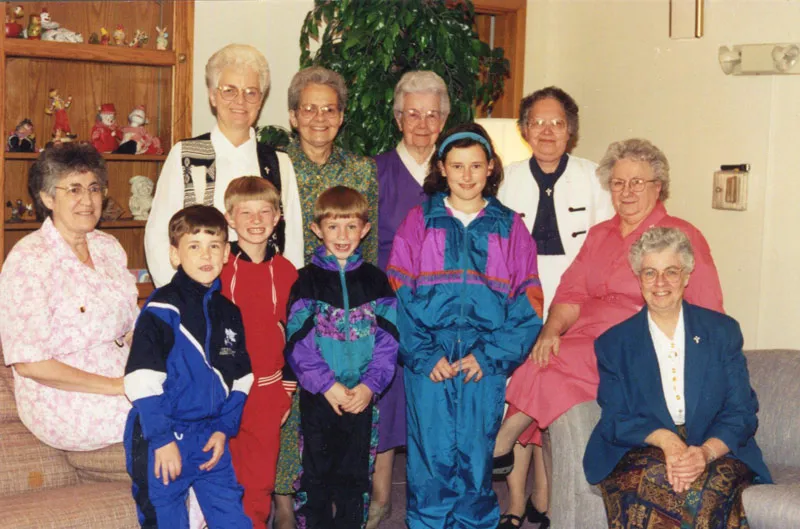
Maria became licensed as a foster parent. Providence House began to accept children at the Holy Family Convent to be sheltered and loved by Maria and the community of Sisters living there.
Success eventually brought with it a request for them to become a group home, and so they opened two – one for girls and one for boys, 10 children in each.
Sister Maria and the Sisters at the Holy Family Convent in New Albany were lovingly referred to as ‘The Church Ladies of New Albany.’ They provided foster care for children as well as education and childcare within the New Albany Housing Authority, reaching out to residents of public housing to teach Adult Basic Education, assist folks to earn their GEDs, and to find jobs.
Two large ministries were happening at the same time. The loving care of children in a licensed foster home demands 24-7 attention to the needs of children: That includes driving children to and from as many as seven different schools each day, homework, working with parents and teachers and caseworkers, attending court hearings and accompanying children to court. It is exhausting, and after three years,
Maria became very ill and came home to the Woods to recover. It was difficult to leave the children, but she intended to return soon.
Take me where you want me to go and keep me out of your way.”
Father Mychal Judge
The Providence that so far had guided Maria now had other plans for this Sister of Providence. The skills gained from 25 years in classrooms and 16 years managing groups of people, educating and advocating – all the experiences gained in a lifetime of being a shelter for those in need – were now needed at the Motherhouse.
First, she was asked to manage the caretaking staff of another Sister of Providence who had been seriously injured. She did that for three years.
Maria had regained her own health and was ready to return to the foster children. She was approached by the General Superior one day and asked if she would oversee Providence Hall.
Maria said, “Oh, Sister. I can’t do that. All I’ve done is take care of little children and foster children. I wouldn’t have a clue what to do with all these nuns!” The Sister told her that she understood.
Maria forgot all about it, thinking she was off the hook for that job and would be headed back to New Albany. “So I’m getting ready to go back to southern Indiana and she meets me in church one day and said, ‘You got the job!’ I just looked at her. She had never once talked to me after that first conversation.”
For the next seven years Maria oversaw Providence Hall, which housed 70 Sisters. She put a team together to help her: Sister Lucy Lechner and Frank Bussing, a brother of three Sisters of Providence, who lived in a nearby housing complex. They worked so well together that the job she was sure she couldn’t do became one of the many she really liked.

Finally, after 10 years at the Woods, Maria was able to return to the foster children, but much had changed since she had last been in southern Indiana.
Guerin Woods had developed and the foster and group homes which had housed 260 children over the years had been replaced by a program that allowed children-at-risk to live with a parent under supervision. They were in Georgetown now, at Guerin Woods.
A senior center had been created, as well as Guerin Senior Apartments, and during the next thirteen years eight additional villas were built to house more seniors. Maria became the Activity Director for each unit. She remains in contact still with some of the family members who had volunteered with her over the years.
Sister Maria and Sister Barbara Ann Zeller – the driving force behind Guerin Woods – worked side-by-side for many years. They had discovered through Maria’s niece that they were related through those four brothers who had come from Germany a century ago; their grandfathers were brothers.
When Sister Barbara Ann became ill and needed care, it was Maria who cared for her daily the final days of her life. After 13 years, at the age of 80, Maria came home to the Woods for her retirement.
To walk in the footsteps of Mary is to do small things with great love.”
Saint Teresa of Calcutta
Sister Maria Smith is truly retired now, if you define retired as “I like to be busy.” She has more time to get to know the women in her community who she didn’t get to know because they were all either in different ministries and missions, or busy taking classes during the summers when everyone was home.
She has stories to tell. Ask her about Tom, and the Sister of Providence in seventh grade who caused her to question her desire for a religious vocation. Ask her about trying to corral a determined young child in front of a Judge in Family Court.
Ask her about lying on the floor, having fallen and unable to get up, at the foot of the stairs to the Blessed Sacrament Chapel for hours on an early Sunday morning before anyone else was up and moving.
Maria shares a deep, mutual love with her many nieces and nephews, who visit her frequently. There is a set of young twins in the family, a first for a family so large.
Although limited in what she can do now because of incessant back pain, she is passionate about prayer ministry and helping as many people as she can, especially with her hand sewing. She feels it is the only thing she’s got to give right now.
“I can’t go to exercises. I can’t join things where there’s a lot of motion. I just say to the Lord, let me help as many as I can.” Sister Maria calls Bingo twice a week and has the much-appreciated reputation of calling the numbers quicker than many others.
The law of love demands that we must become the people of the towel and water.”
Catherine du Hueck Doherty
Sister Maria entered the congregation when there were 1,500 Sisters of Providence. She had known she wanted to be a Sister of Providence when she was only eight years old and has never questioned that except briefly in seventh grade. She carries the spirit of her mother within her and has walked the path of Saint Mother Theodore Guerin that Providence designed for her.
Maria loved and taught hundreds of first graders for 25 years, was an administrator of Providence Hall at the Motherhouse, and parented foster children.
She has listened to the memories of seniors as they engaged in activities and was a safe place for the heartbreaking stories that abused and neglected foster children shared.

In spite of and because of her humble beginnings, Maria has walked comfortably among a variety of people all her life. She has followed the Creator’s call, prays without ceasing, and is deeply committed to her devotion to the Blessed Mother.
Sister Maria has touched the lives of hundreds of people who were just looking for some shelter from what life handed them. She was the shade, one of the ‘Church Ladies of New Albany.’
Sister Maria Smith has honored Mother Theodore by being love, mercy and justice in this world. “Lord…let me help as many as I can” is not just her prayer now; it has been Sister Maria Smith’s mantra her entire life, and we have all been blessed because she followed God’s call to serve.