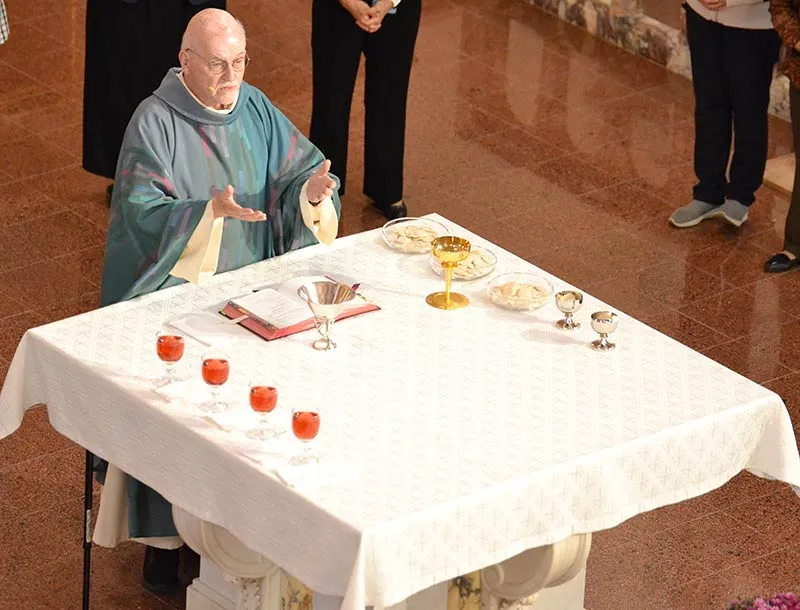
Note: The following is the reflection Father Terry Johnson offered during the Sunday, October 11, 2026, 20th celebration of the canonization of Saint Mother Theodore Guerin.
What does the canonization of Mother Theodore mean?
What does it mean for the citizens of the Wabash Valley? And what does it mean for the Sisters of Providence, Providence Associates, and all who share the Charism of Providence?
Those are important questions as we celebrate the twentieth anniversary of Mother Theodore Guerin’s canonization.
On October 15, 2006, Pope Benedict XVI declared Mother Theodore a saint of the universal Church. Twenty years later, we might be tempted simply to look back—to remember Rome, the celebration, and the joy of that day.
But perhaps the better way to understand these twenty years is as a pilgrimage.
Canonization did not bring Mother Theodore’s journey to an end. It opened her story more widely and invites us to ask: Where has this pilgrimage brought us, and where is Providence calling us now?
The first reading from Isaiah offers us a beautiful image for that pilgrimage. God prepares a feast for all peoples, wipes away tears, and removes what separates us. It is a vision of God’s dream for creation: a world where there is enough, everyone has a place at the table, what is broken is healed, and life is shared in abundance.
That is also a vision of holiness.
Holiness is not simply becoming a very good or religious person. It is allowing our lives to become part of God’s work of healing, reconciliation, welcome and abundant life.
And that helps us understand Mother Theodore.
When she came to Saint Mary-of-the-Woods in 1840, she arrived in what seemed like wilderness, facing uncertainty, hardship and questions about whether the new foundation would survive.
Yet she learned to see possibility where others might have seen only difficulty. She wrote:
“What confidence this wilderness inspires! Everything speaks to us of God.”
She learned to pay attention.
She recognized God’s presence in the wilderness, found an invitation to trust amid hardship, and saw the people around her as entrusted to her care. She recognized the land not simply as property, but as creation filled with possibility.
For Mother Theodore, God, people and creation were not separate realities. Providence was the relationship that held everything together.
Perhaps this is one of the great gifts she offers us twenty years after her canonization: a vision of holiness that calls us into right relationship with God, with one another, and with all creation.
This vision continues in the mission of the Sisters of Providence: to honor Divine Providence by participating in God’s loving work through love, mercy and justice.
So, what does Mother Theodore’s canonization mean for the citizens of the Wabash Valley?
Her story is woven into the story of this place. She walked this land, prayed here, struggled here, educated here and welcomed people here. Her holiness took root in the soil of the Wabash Valley.
And perhaps her presence continues to ask this community:
What does it mean to live in right relationship with this place entrusted to us?
How do we care for the land, the waters, the creatures, and the people and communities of this valley? How do we learn, as Mother Theodore did, to look at the world around us and say, “Everything speaks to us of God”?
And what does her canonization mean for the Sisters of Providence, Providence Associates, and all who share the Charism of Providence?
Perhaps this is where the anniversary becomes most personal.
We are not simply celebrating what Mother Theodore did. We are asking what her life is asking of us.
A charism is not a museum piece. It is a gift of the Spirit that continues to take flesh in new times, new circumstances and new people.
Mother Theodore lived Providence in nineteenth-century Indiana. We are called to live Providence in the twenty-first century.
The world has changed, and the challenges facing humanity and creation have changed. But the invitation remains:
Honor Divine Providence. Pay attention to the signs of the times. Respond with courage. Pray. Educate. Serve. Advocate. Work for love, mercy and justice. Stand with those whose dignity is threatened or forgotten. Care for Earth and the whole community of creation entrusted to us.
That call is especially urgent in our own time. Archbishop Paul Coakley, the president of the U.S. Conference of Catholic Bishops has condemned plans to livestream a public execution, reminding us that “our God is the God of life.” Isaiah’s vision of God’s banquet is a vision of a world where suffering is met with healing and life is not diminished by revenge. Mother Theodore’s charism challenges us to resist a culture of death and to build a world where human dignity is honored, mercy is practiced and hope remains possible—even when society seeks vengeance rather than justice.
This is not simply a list of things to do. It is a way of living Providence—a way of participating in God’s loving plans for our world.
So perhaps the most important question for this twentieth anniversary is not simply, What did Mother Theodore do? or What did her canonization mean twenty years ago?
It is this:
How does Mother Theodore’s charism want to live through us now?
Perhaps it means having her courage to enter today’s wildernesses without knowing exactly what will happen. Perhaps it means paying attention to the cries of people who are suffering, the needs of our communities, and the cry of Earth.
Perhaps it means recovering her sense of wonder—looking at the forests, waters, gardens, animals and changing seasons, and remembering: Everything speaks to us of God.
And perhaps it means upholding the sacredness of all creation, recognizing that the world around us is not simply something to use, but something to receive, reverence and protect.
Our call is to help prepare the banquet Isaiah describes: a world where everyone has a place, every person’s dignity is honored, tears are wiped away, and people and creation can flourish together.
Mother Theodore could not have known the world in which we live today. But she knew how to listen, how to trust, and how to respond. She knew that Providence was not simply something to believe in.
Providence was something to live.
Twenty years ago, the Church recognized Mother Theodore’s holiness. Today, we are invited to recognize that her pilgrimage is still going on.
It continues whenever someone trusts Providence amid uncertainty, welcomes another person to the table, chooses compassion over indifference, works for love, mercy and justice, honors human dignity, or cares for Earth and the creatures with whom we share our common home.
Today, we do not simply celebrate a saint who lived in the past. We celebrate a woman whose pilgrimage has become part of our own.
For the citizens of the Wabash Valley. For all who have been touched by the Sisters of Providence. For the Sisters of Providence and Providence Associates. For all who share this charism.
We are still walking with Mother Theodore, and Providence is still calling us forward.
Where is Providence inviting us to walk now—and how does Mother Theodore’s charism want to live through us now?