Journalism and First Amendment Rights

Note: The following piece was co-authored by Providence Associates Jane Fischer and Suzie Ray as part of the 28th JUSTus Podcast.
Even though the United States celebrated its 250th Anniversary on July 4th, globally, we are a very young country. Iran goes back 5,000 years. Japan has been around for over 2,000 years. And Portugal is 877 years old. Turtle Island, the land on which the U.S. is located, is billions of years old. But our country … only 250.
Declaring independence for the U.S. was one event in time. Becoming independent is another. We tend to forget that the United States was not created overnight and has been evolving since its founding. There were 4,092 days between the Declaration of Independence and the signing of the U.S. Constitution. And more than 68,985 days (189 years) before everyone living in this country, on this land, were given their civil rights and civil liberties – citizenship rights.
The Evolution of the U.S. Democracy
- July 4, 1776: Signing of the Declaration of Independence,
- September 17, 1787: Signing of the Constitution (4,092 days later),
- June 21, 1788: Ratification of the Constitution (4,368 days later),
- March 4, 1789: U.S. Open for Business (4,528 days later),
- September 25, 1789: Signing of the Bill of Rights (4,745 days later),
- January 1, 1863: Emancipation Proclamation (31,755 days later),
- June 2, 1924: Indian Citizen Act (54,020 days later), and
- July 2, 1965: Civil Rights Act (68,985 days later).
In the past, mail delays between locations allowed our representatives, journalists, and news sources time to draft and edit their opinions, providing for discussions, research, and reflection. Today, with the help of technology, time to reflect and discuss has been erased. The delivery of information – opinions, reactions, and responses – is instant. This instantaneous flow of information causes the spread of misinformation, disinformation, confusion, and conflict. The result? We are less informed than we were in 1776.
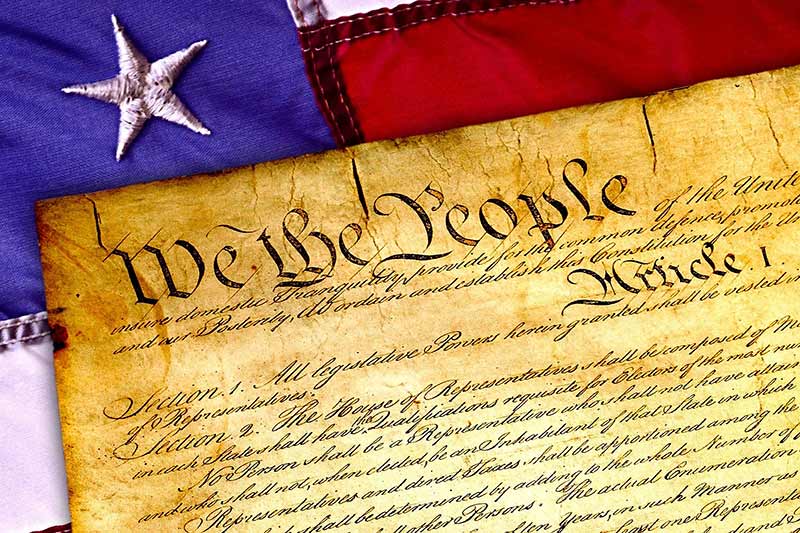
Yes, as Americans, we still fiercely believe in our five core freedoms provided by the Constitution and the Bill of Rights. And we balk loudly and often at any attempts to squash them.
- Freedom of Religion:
- The Estbalishment Clause. The government cannot establish an official religion or promote religion over non-religion,
- The Free Exercise Clause. The government cannot stop you from practicing your faith,
- The Johnson Amendment. Enacted in 1954, the Johnson Amendment Rule was adopted, declaring that when achieving tax-exempt status, a charitable nonprofit, foundation, or religious organization may “not participate in, or intervene in (including the publishing or distributing of statements), any political campaign on behalf of (or in opposition to) any candidate for public office,
- Freedom of Speech: We can freely express our thoughts, opinions, and beliefs without government censorship or retaliation. In the United States, the First Amendment fully protects speech on the internet to the same level as traditional print media. According to the U.S. Supreme Court decision in 1997, this means that the government cannot censor online expression or ban offensive speech, such as online hate speech. That is 75,869 days after the signing of the Bill of Rights. By this time, communication and publication technologies had been through several iterations, and the internet was on its way. Today, offensive and hate speech have become the norm.
- Freedom of the Press: Journalists and media outlets can investigate, criticize, and report on the government without fear of censorship or retaliation. However, not without consequences. For example:
- On May 7, 1945 in France, “Ed Kennedy defied the (US) military censors to report the Nazi surrender. For this, he was first rebuked by the Associated Press (AP), then fired. AP has said Kennedy did the right thing in breaking the embargo.” Kennedy later wrote, “The absurdity of attempting to bottle up news of such magnitude was too apparent.” According to Tom Curley, who wrote the introduction to Kennedy’s biography, “It was a terrible day for the AP. It was handled in the worst possible way.”
- Even in 2026, we have witnessed the firings of a significant number of journalists for their reporting of government actions. CBS News fired or refused to extend contracts for longtime 60 Minutes correspondents Scott Pelley, Sharyn Alfonsi, and Cecilia Vega amid a massive restructuring of the show. They also ousted executive producer Tanya Simon and executive editor Draggan Mihailovich. That includes satirical comedians, such as Stephen Colbert, whose contract was not extended. It is widely believed that it is primarily due to his constant and consistent comedic reporting of government actions.
- Freedom of Assembly: We have the right to peacefully gather in groups for protests, advocacy, or other communal purposes. Again, there are consequences. In the 1950s and 1960s, we witnessed law enforcement attacking peaceful protestors throughout the South. Fast forward to January 2026, where we saw incidents of law enforcement attacking peaceful protestors and protestors becoming violent. To the extent that the City of Minneapolis had to send a message to protestors reminding them of their rights, as well as what was unlawful: “People have the right to peacefully protest and exercise their First Amendment rights. People can assemble peacefully in public spaces and on sidewalks, not roadways or freeways. They can carry signs and chant. They cannot throw objects, start fires, or damage property. They also cannot use fireworks or weapons.”
- Freedom of Petition: You can demand changes or solutions from the government through lawsuits, lobbying, contacting representatives, or peaceful protests.
Freedom Isn’t Free
Yes, as American citizens and as immigrants who have chosen the United States as their home, we must remember that “Freedom isn’t free! You gotta pay a price, you gotta sacrifice for your liberty!” For years, we have witnessed the decline in the journalism field. Some of this is due to the advent of the technology era. Other reasons include the decline in the availability of written media and the decline in people’s willingness to pay for subscriptions. Paid subscriptions are the primary source of revenue for the news media. A. G. Sulzberger speaks to this in a NY Times podcast earlier this year, in March.
This is A.G. Sulzberger. I’m the publisher of The New York Times. I oversee our news operations and our business. But I’m also a former reporter who has watched with a lot of alarm as our profession has shrunk and shrunk in recent years. Normally, in these ads, we talk about the importance of subscribing to The Times. I’m here today with a different message. I’m encouraging you to support any news organization that’s dedicated to original reporting. If that’s your local newspaper, terrific — local newspapers in particular need your support. If that’s another national newspaper, that’s great too. And if it’s the New York Times, we’ll use that money to send reporters out to find the facts and context that you’ll never get from AI. That’s it, not asking you to click on any link, just subscribe to a real news organization with real journalists doing firsthand, fact-based reporting. And if you already do, thank you.
In April of this year, the Pew Research Center reported that “The way Americans get the news from their local newspapers has moved even further in a digital direction. About two-thirds of those who say they get news from local daily newspapers (68 percent) primarily get that news online, compared with 43 percent in 2018.”
But the real issue, I believe, is the decline in trust in journalism. We have entered an era of Fake News, Alternative Facts, and Deep Fake AI. Chris R. Vaccaro, President of the Society of Professional Journalists, writes about the hatred of the press. He stated that the “hatred toward the press today feels more corrosive than at any point in modern American history. Yet one thing remains certain: The First Amendment exists for a reason. The American people deserve reliable, independent journalism that informs and engages them. And the industry must evolve … in every way.
Evolution cannot just mean digital distribution. It must include:
- Sustainable business models,
- Smarter staffing and infrastructure decisions,
- Modern storytelling formats,
- Transparency about mission and purpose, and
- Relentless community engagement.
“The Society of Professional Journalists champions journalists by recognizing outstanding achievement, fighting to protect press freedom, promoting high ethical standards, and educating new generations of emerging professionals.”
American Citizens have an obligation to seek the truth in reporting. We must seek out reporting that “speaks truth to power” as addressed in an article from the Robert and Ethel Kennedy Human Rights Center:
“Today we find ourselves in a time when specific narratives are being removed from our collective history, erased from libraries and curricula. Educators are being told what to teach and how to teach it. Now more than ever, we need to ensure that our collective national narrative is truly reflective of who we are – the good, the bad, the resilient, the courageous, the defender of human rights and social justice.“
Well … What about Sources Like Fox News, you ask. As a matter of course, FOX News will slant its reporting to support whatever the Republican Party and President Trump are currently advocating. Recall that in 2023, “Fox News agreed to pay Dominion Voting Systems nearly $800 million to avert a trial in the voting machine company’s lawsuit that would have exposed how the network promoted lies about the 2020 presidential election. Dominion set out to prove in the lawsuit that Fox acted with malice in airing allegations that it knew to be false, or with “reckless disregard” for the truth. It presented volumes of internal emails and text messages that showed Fox executives and personalities saying they knew the accusations were untrue, even as the falsehoods were aired on programs hosted by Maria Bartiromo, Lou Dobbs and Jeanine Pirro.”
We cannot do anything about Fox News. This goes back to one of our five core freedoms, the Freedom of Speech. Our job as social justice advocates is to engage. “Relentless community engagement” is not just crucial; it is essential. The decline in the number of local daily newspapers delivered to homes has significantly affected the spread of information. Some attribute the COVID-19 crisis to the decrease in local interactions. According to a study published in 2023 by PubMedCenter, “There are seven major areas that have been negatively affected by the COVID-19 pandemic: health, social vulnerability, education, social capital, social relationships, social mobility, and social welfare [emphasis added]. In 2024, the Survey Center on American Life reported that, “Americans have smaller social networks and fewer friends, and they spend less time with their friends, neighbors, and family members.
This state of affairs has led Surgeon General Vivek Murthy to declare that the United States is facing an “epidemic of loneliness and isolation.” Due to a lack of local news, fewer social contacts, and the explosion of misinformation, disinformation, alternative facts, fake news, and deepfake AI, Americans may be less informed than ever.
Call to Action
- Spend time learning how to spot fake news, deepfake AI, and alternative facts.
- Choose your news sources wisely. Find out who the publishers are. Do their financial interests govern the perspective of the story?
- Support your local news publisher.
- Take a journalism course. If you are already a writer, submit community interest stories to your local newspaper.
- Join an organization and get to know some new people. Broaden your horizons. Learning new things can change your perspective. “Gentle or meek does not mean standing in the shadows silently. It means not being arrogant about my opinions. Being gentle allows me to listen with humility and curiosity to opinions and views that are diametrically opposed to mine. Being meek means I can offer my thoughts to have a conversation rather than a monologue.” Sister Sue Paweski, SP, “The Beatitudes: The Journey to Reconciliation.”
- Become a believer in the oral tradition by gathering with community members to find out what is happening in the neighborhood.