Note: The following piece was co-authored by Providence Associates Jane Fischer and Dr. Pearlette Springer for the JUSTus 25th Podcast Episode.
The term “justice” is linked to criminal or civil contexts, while the terms restorative justice and social justice are linked to relationships.
In contrast, “land justice” is a concept that focuses on the treatment of land, including issues related to land rights and ownership.
This term was first introduced in the 1930s by organizations such as the Australian Aboriginal Progressive Association.
We learned about land in our backyards and through the Bible, as in the “Land of Cana” and the “Land of the Israelites.”
We also read that “under Mosaic Law, land was returned to the original owner every 50 years,” (Leviticus 25:23-28).
Imagine having to give your land back 50 years after you bought it!
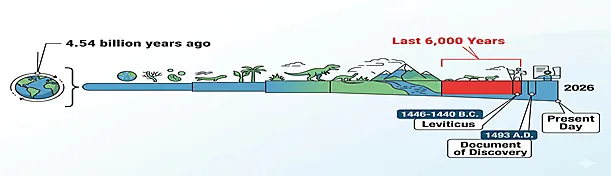
Look at Earth’s timeline above. Notice when science marks its beginning on the left.
Many of us learned about “Earth” through the Book of Genesis … as in “God created the earth.” Brother Guy J. Consolmagno, S.J. (Astronomer and President of the Vatican Observatory Foundation) says, “Genesis is not a book about science; Genesis is a book about God … (and) … it had to be written poetically because the science keeps changing.”
Catholics do not interpret scripture literally, and we know that some biblical scholars may not agree. The fact is that God is in everything and for all time. And God does not change. But humans do.
As humans, our understanding is shaped by what we know, experience, and read throughout our lives. However, God exists beyond the constraints of time.
Brother Consolmagno once stated, “Science should be for the glory of God.” This perspective allows us to interpret Genesis in a new light. A book like Genesis, read today, is not interpreted the same way it might have been in biblical times.
God exists beyond the constraints of time. Brother Consolmagno also said, “Science should be for the glory of God.” This perspective allows us to interpret Genesis from a different perspective.
When examining terminology such as “earth,” “land,” and “ownership,” it is helpful to reflect on the age of God’s creations. We must keep in mind what people understood in their time. Their intentions were justified by what they were taught and understood. In 2026, what humans learn, know, and understand is quite different from before and after Christ.
To understand Land Justice today, we must understand the source of land “ownership,” and the Doctrine of Discovery (published in three different Papal Bulls between 1452 and 1493). It’s important to remember that property ownership in the United States today is very different.
Looking at the Earth’s Timeline above, just how old is Earth … and in terms of Land Justice, what does owning land even mean? The “owner” depends upon where ownership is on the timeline, doesn’t it?
For example, Bethlehem is first mentioned in Genesis 35:19-21, which was approximately 1897 BC. Rules of ownership in 1897 BC would be way at the far left of the timeline.
Ownership of land in the United States was reserved for whites only until 1866, which is at the far right side of the timeline. A page of the National Park Service called “The Trail of Tears” describes what happened:
“Between 1816 and 1840, (when) tribes located between the original states and the Mississippi River, including Cherokees, Chickasaws, Choctaws, Creeks, and Seminoles, signed more than 40 treaties ceding their lands to the U.S. In his 1829 inaugural address, President Andrew Jackson set a policy to relocate eastern Indians.” There is much more written about this, but note this just about the Cherokee Nation: “Approximately 16,000 to 17,000 Cherokee were forcibly removed, with about 4,000 (roughly one-fifth to one-third of the population) losing their lives.”
Take a breath before you read this part from Genesis, Chapter 1: Then God said: Let us make human beings in our image, after our likeness. Let them have dominion over the fish of the sea, the birds of the air, the tame animals, all the wild animals, and all the creatures that crawl on the earth.”
When America was “discovered” and later when colonies were established, the Christians who arrived saw people who did not appear to be “in God’s image” (as in paintings).
They also saw people who did not cultivate and fence off property, ate strange foods, and worshiped false gods.
Since these people on Turtle Island, aka North America, were not in God’s image, they had no right to the land. Many did not cover their bodies fully with clothing!
Following the Doctrine of Discovery, land was taken and turned over to the Monarchs, and eventually to the Discoverers.
Planting the Monarch’s flag declared ownership. It is easy to see how much later “Westward Ho” became the call to land grabbing. The Gold Rush of 1848 gave the 49ers “an open-access race for a small number of high-value deposits …”
The concept of quickly claiming land ownership by merely placing stakes in the ground seems unimaginable today. However, when considering Earth’s timeline, it’s important to see that people on Earth were using and occupying the land long before the arrival of Christian settlers and the ensuing land seizures.
Today, when buying or selling property, a legal process is followed to create a Deed of Ownership. This document formally transfers the property from the previous owner (the Grantor) to the new owner (the Grantee). The idea of quickly claiming land ownership by simply establishing clear boundaries seems unimaginable.
However, looking at Earth’s timeline again, we must recognize that the Earth’s people were using the land long before the arrival of Christians and the subsequent land grabs. Documents are filed in the County Courthouse and become a binding legal record.
Treaties between the U.S. Government and the Indigenous people were written, witnessed, and documented as well, but we know these “legal transfers” were later ignored.
The government, settlers, and pioneers simply “took” the land. It wasn’t peaceful, but it was “legal.” Treaties with the government and indigenous peoples were executed but ignored.
We, White and Christian, had the right to take land from the “pagans” because land/earth was created for God’s people (Christians).
Joint Statement of the Dicasteries for Culture and Education for Promoting Integral Human Development on the “Doctrine of Discovery,” 30.03.2023
| The “doctrine of discovery” is not part of the teaching of the Catholic Church. Historical research clearly demonstrates that the papal documents in question, written in a specific historical period and linked to political questions, have never been considered expressions of the Catholic faith. At the same time, the Church acknowledges that these papal bulls did not adequately reflectthe equal dignity and rights of indigenous peoples. The Church is also aware that the contents of these documents were manipulated for political purposes by competing colonial powers in order to justify immoral acts against indigenous peoples that were carried out, at times, without opposition from ecclesiastical authorities. It is only just to recognize these errors, acknowledge the terrible effects of the assimilation policies and the pain experienced by indigenous peoples, and ask for pardon. Furthermore, Pope Francis has urged: “Never again can the Christian community allow itself to be infected by the idea that one culture is superior to others, or that it is legitimate to employ ways of coercing others.” |
Lest we believe that the Mexicans and Spaniards first settled most of North America, the Library of Congress’s Digital Collection shows that the first indigenous people here “were adventurous Asians who made their way across the Bering Straits to Alaska thousands of years ago when a warmer climate and a now-vanished land bridge made such travel easier. These men and women and their descendants settled North and South America, spreading out to form the various nations and tribes whom the first European visitors to this hemisphere dubbed “Indians.”
Today, we stand at the far right of Earth’s timeline, facing new information that alters our perspective and challenges what we learned in school. Here, Mary of Nazareth can be our guide (Luke 1:46-55), “when God looked with favor on his lowly servant.” Mary’s willingness to accept the news was the catalyst to Jesus’ birth … and the world turned.
The “Canticle of the Turning,” a contemporary hymn by Rory Cooney, focuses on God overturning unjust social structures. It signifies a revolution of justice, where the “lowly” are lifted, the hungry are fed, and the “world is about to turn.” Lyrics shown here.
Pause and take a breath again.
Now, consider a more recent focus on land justice through the lens of landowners who are members of religious orders, specifically Catholic Sisters. “Land Justice Futures helps religious landowners pursue land justice — centering racial repair, ecological healing, and community power into decisions about how land is loved, used, and governed.
While it can take many, many forms, at its core, land justice is about interrupting the story of land as commodity, and living instead as though repair and reciprocity are possible. Drawing on deep study and practical experience, we accompany, support, and educate religious leaders who want to explore what those possibilities could look like in their own communities.”
The Sisters of Providence Land Justice Futures team (LJF) is in its second year of study and discernment. The team is composed of five members, including both Sisters, Associates, and partners.
During this phase, they are meeting with staff from the LJF organization and with other religious orders in the same cohort.

Q: Is Land Justice Futures taking advantage of religious communities in our diminishment?
A: LJF defines land justice as centering racial and ecological healing in how we relate to land. Sister Chris Loughlin, OP, an early advisor to the LJF team, encouraged them with these words: “What you love, we will love. Tell the Sisters what you are in love with, and they will love it, too.” We, the SP Land Justice Futures Team [at SPSMW], see becoming a focus community with Land Justice Futures as a deepening of our Land Ethic and an opportunity for integrating the ministry of the White Violet Center, the Climate Crisis Task Force, and the Task Force on Racial Equity and Equality into our community discernment on land protection, regeneration, and restoration.
When asked about the challenges facing religious communities in America, a Sister of another focus community expressed it this way: “For 20 years now, I feel like we have been preparing to die, and this work of land justice is helping me to feel like we are now beginning to live.”
And, from a member of our SP team, “This work is not about being used or diminished. It is about reclaiming vitality, mission, and hope rooted in land, in right relationship, and in the future we are called to help shape.”
We’d love to include your questions in future posts. If you have anything you are wondering about or would like more information on, please submit your request to Cassie Sutton, General Secretary at csutton@spsmw.org or 812-535-2862.
| Topic | Description |
| Dakota Access Pipeline | The Sioux territory that is now Standing Rock lost even more land in 1944, when the Corps took 87.5 square miles via eminent domain as part of a larger project to construct five dams and reservoirs along the Missouri River. “The Oahe Dam destroyed more Indian land than any other single public works project in the United States,” wrote historian Michael L. Lawson in his book Dammed Indians Revisited. |
| Hunting and Fishing Legal Rights | For many centuries, Native American tribes have relied on hunting and fishing for subsistence and trade. Some tribes even migrated according to the movements of fish. The federal government generally guaranteed hunting and fishing rights when signing treaties with tribes in which the tribes gave up their lands. |
| Conservation Easement | … permanent protection of more than 43 acres of globally rare pine barrens owned by the Sisters of St. Joseph in Brentwood, the town of Islip. DEC acquired a conservation easement from the Sisters and will jointly manage the property with them to protect groundwater and habitat, as well as provide public access to open space in an area historically underserved by parkland. |
| Oak Flat | …the fight to protect Oak Flat isn’t just an economic or political or legal battle. Instead, Nosie has referred to it as a “holy war” in defense of the land, a 6.7-square-mile stretch within Tonto National Forest. The area is east of Phoenix and not far from several reservations, including the San Carlos Apache Reservation. |
| Catholic Sisters and Oak Flat | Nine sisters representing seven congregations joined Apache elders and others during three days of peaceful demonstrations, July 18-20, in defense of Oak Flat, or Chi’chil Bildagoteel, as the Apache call it. The congregations included Sisters of Mercy, Dominicans of Peace, Sisters of St. Joseph, Sisters of Providence, Sisters of Loretto, Franciscan Sisters of Perpetual Adoration and Sisters of Charity. |
| Nature Conservancy | The Six Nations Iroquois Cultural Center (6NICC) has acquired 600 acres of wooded property in Onchiota, NY, in one of the largest returns of private land to Indigenous people in state history. |
| Groundwater and habitat protection, and public access | New York State Department of Environmental Conservation (DEC) Commissioner Amanda Lefton today announced the permanent protection of more than 43 acres of globally rare pine barrens owned by the Sisters of St. Joseph in Brentwood, town of Islip. DEC acquired a conservation easement from the Sisters and will jointly manage the property with them for groundwater and habitat protection and public access to open space in an area historically underserved by parkland. |
| Franciscan Sisters of Perpetual Adoration turned over land to the Lac du Flambeau Band of Lake Superior Chippewa Indians | An order of Catholic nuns in Wisconsin recently returned land they had purchased in 1966 to the Indigenous tribe that originally settled it. …. Though it’s now worth millions, they gave it back for the same $30,000 they themselves paid when they purchased it in 1966. |
| St. Regis Mohawk Tribe Dispute | Returns land back to tribal control with payments from the New York Power Authority for Use of the Land and Access to Power |
| Native American Rights Fund | On December 9, 2016, President Obama signed a landmark Executive Order creating the Northern Bering Sea Climate Resilience Area. This was an incredible victory for the Bering Sea Elders Group, and the first protections of its kind for tribes anywhere in the United States. … on April 28, 2017, President Trump signed an executive order called “Implementing an America-First Offshore Energy Strategy.” While the order was aimed at re-opening Arctic and Atlantic areas for offshore drilling, it also entirely revoked our Executive Order 13754. This reversal occurred without notice and despite all indications that the suite of northern Bering Sea protections—including the focus on the role of Tribes in future decisions—were not in danger. |
| Onondaga Nation over 1,000 acres transferred in New York | Significant land transfer efforts in New York include the June 2022 return of over 1,000 acres in the Tully Valley to the Onondaga Nation. While this major restitution occurred in Central New York, it highlights a broader movement, including agreements with the Saint Regis Mohawk Tribe and active land repatriation advocacy across New York State. |
As members of one sacred Earth community, we Sisters of Providence commit ourselves individually and communally to care for our resources and to make decisions regarding their current and future use as we seek to balance our individual and SP communal economic needs with the sustainability needs of the Earth community.
Read our entire Land Ethic here.
Australian Aboriginal Progressive Association (n.d.). Formation of the A.P.A. National Australian Museum. https://www.nma.gov.au/defining-moments/resources/formation-of-the-aapa
Cherokee Nation (n.d.). ᎾᏍᎩ ᎠᏅᏓᏗᏍᏗ ᏗᎨᏥᎧᎲᏍᏒᎢ. Remember the Removal. https://www.cherokee.org/about-the-nation/remember-the-removal/our-journey/
Clay, Karen & Wright, Gavin. (May, 2004). Order without Law? Property Assignments during the California Gold Rush. Stanford Institute for Economic Policy Research. https://siepr.stanford.edu/publications/working-paper/order-without-law-property-rights-during-california-gold-rush
Cooney, Rory. (n.d.) https://www.graceiseverywhere.net/2015/05/11/canticle-of-the-turning/
Department of Environmental Conservation (July 02, 2025). DEC Announces New 43-Acre Conservation Easement to Preserve Open Space in Brentwood. https://dec.ny.gov/news/press-releases/2025/7/dec-announces-new-43-acre-conservation-easement-to-preserve-open-space-in-brentwood
Doctrine of Discovery (n.d.). Upstander Project. https://upstanderproject.org/learn/guides-and-resources/first-light/doctrine-of-discovery#:~:text=Two%20papal%20bulls%2C%20in%20particular%2C,of%20trade%20with%20Africa%20and
Escobar, David. North Country Public Radio. (March 14, 2026). Six Nations Iroquois Cultural Center acquires 600 acres in Onchiota. https://www.northcountrypublicradio.org/news/story/53156/20260314/six-nations-iroquois-cultural-center-acquires-600-acres-in-onchiota?fbclid=IwY2xjawQmdpZleHRuA2FlbQIxMABicmlkETFPYVhwcjVyQ1RnSnJWNXdRc3J0YwZhcHBfaWQQMjIyMDM5MTc4ODIwMDg5MgABHtw_gSp5kFgUwd_nSJtlaeA2hzeFPTuYIenJyk18lG1DVpuhT-_HvPdMEGYv_aem_FCl9HfLsU9-1PKVBlq_3HA
Herlinger, Chris. Global Sisters Report. (July 21, 2025). Sisters support defense of Apache sacred site, ‘religious freedom for Native Americans.’ https://www.globalsistersreport.org/environment/sisters-support-defense-apache-sacred-site-religious-freedom-native-americans
Holy See Press Office (March 30, 2023). Summary of Bulletin. Joint Statement of the Dicasteries for Culture and Education and for Promoting Integral Human Development on the Doctrine of Discovery. https://press.vatican.va/content/salastampa/en/bollettino/pubblico/2023/03/30/230330b.html
Hu, Sheila. Dakota Pipeline. (June 12, 2024). The Dakota Access Pipeline: What you Need to Know. https://www.nrdc.org/stories/dakota-access-pipeline-what-you-need-know
Justia (July, 2025). Hunting and Fishing Legal Rights of Native Americans. https://www.justia.com/native-american-law/hunting-and-fishing-rights-of-native-americans/
Land Justice Futures (2026). Healing Stories on Sacred Lands. Retrieved 3/24/3026. https://www.landjusticefutures.org/
Library of Congress Digital Collection (n.d.). The First Peoples of California. California as I Saw It: First-Person Narratives of California’s Early Years, 1849 to 1900. https://www.loc.gov/collections/california-first-person-narratives/articles-and-essays/early-california-history/first-peoples-of-california/
Molina, Alejandra. National Catholic Reporter (March 16, 2021). Why Oak Flat in Arizona is a Sacred Place. https://www.ncronline.org/news/why-oak-flat-arizona-sacred-space-apache-and-other-native-americansl
Native American Rights Fund. (n.d.) Bering Sea Elders Group. https://narf.org/cases/bering-sea-elders-group/
Onondaga Nation People of the Hills. (September 24, 2022). Agreement Transferring 1,000 Acres in Tully Creek Area Completed. https://www.onondaganation.org/news/2024/agreement-transferring-1000-acres-in-tulley-creek-area-completed/
Sisters of Providence (June, 2012). Land Ethic. https://spsmw.org/about/justice/laudato-si/land-ethic/
State of New York, Governor’s Office. Hochul, Kathy. (September 25, 2025). Governor Hochul Announces Agreement Reached with Saint Regis Mohawk Tribe, Ending Decades Long Dispute. https://www.governor.ny.gov/news/governor-hochul-announces-agreement-reached-saint-regis-mohawk-tribe-ending-decades-long
Washington, Robin. (November 29, 2025). Catholic nuns in Wisconsin return land bought in 1966 to an Indigenous tribe. https://www.npr.org/2025/11/29/nx-s1-5615173/catholic-nuns-in-wisconsin-return-land-bought-in-1966-to-an-indigenous-tribe